
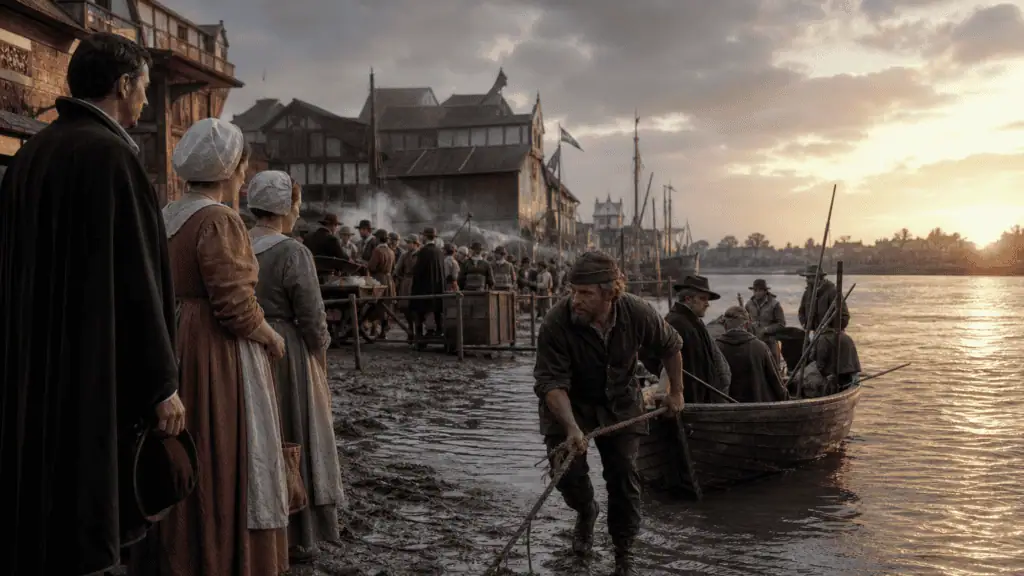
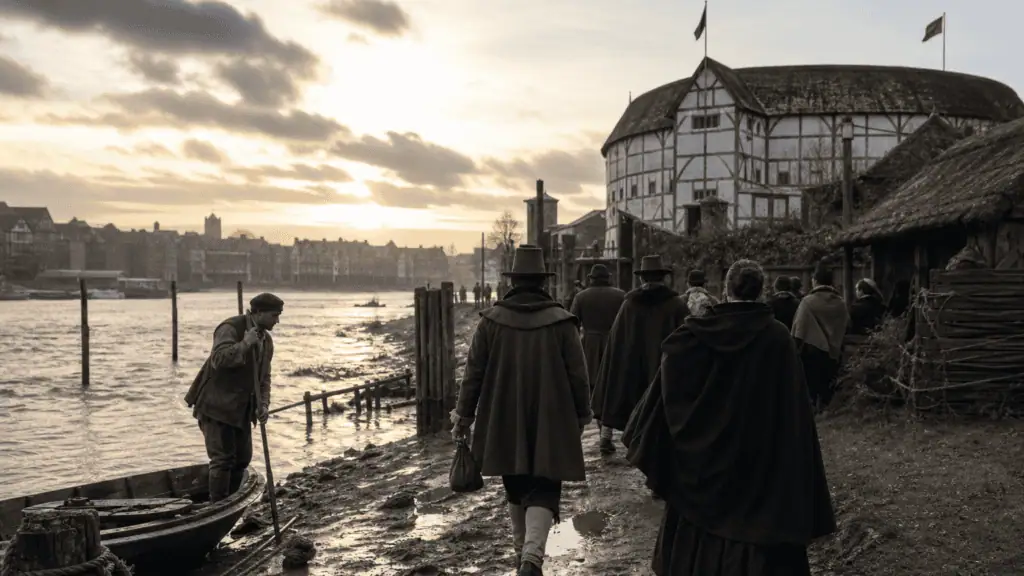
The afternoon crossing to the Bankside was never just a journey to a playhouse. It was a small act of participation in the making of Elizabethan London. By the late sixteenth century, the south bank of the Thames had become a place where ordinary lives gathered in unusually close company. A waterman pulled his boat towards the landing place. Apprentices arrived with their masters, women argued over the price of entry, labourers laughed and jostled, and a gentleman in fine clothing tried to preserve his privacy inside a public crowd. Long before the first actor spoke, the theatre had already begun to work on the people around it. It had drawn them out of their separate routines and placed them into a shared moment of expectation.
That is why Elizabethan theatre mattered more than entertainment. It was not simply something to watch after work, or a novelty for the curious. It was part of the daily rhythm of a growing city. In London, where migration constantly changed the texture of streets and markets, performance offered a form of public life that could be entered by anyone with a penny and the will to stand among strangers. The poorest spectators stood in the yard and watched from close range. Others sat in galleries or private rooms. Their social rank remained visible, but they still heard the same words and shared the same event. That mixture of separation and common attention made the playhouse one of the most revealing spaces in Elizabethan England and daily life.
The theatre became important because it brought together people who might never have spoken to one another elsewhere. It gave servants, merchants, sailors, apprentices, and householders access to stories, arguments, and emotions that would once have been confined to courts or elite households. It also created a new relationship between audience and authority. Drama could flatter power, question power, or expose the anxieties that surrounded power without ever naming the present too directly. For a culture shaped by censorship, patronage, religion, and social discipline, that was a remarkable achievement.
If we remember only the most famous playwrights, we miss the deeper history. Elizabethan theatre was not made by genius alone. It was made by audiences, workers, investors, city officials, and the shifting needs of London itself. To understand its significance, we need to look not only at the words spoken on stage but at the crowd that made those words matter.
Professor Amelia Harcourt takes you through the story of why this event mattered more than people realise.
Why a Penny Changed the City
A penny was a small sum, but in Elizabethan London it could open the door to an entire social world. Low admission fees transformed performance from a rare luxury into a regular habit. This mattered because the city itself was changing quickly. London was swelling with migrants from the countryside, young people seeking work, apprentices under strict discipline, tradespeople chasing opportunity, and households trying to survive in a crowded economy. In that environment, theatre became part of the urban routine, not an exceptional outing reserved for the wealthy.
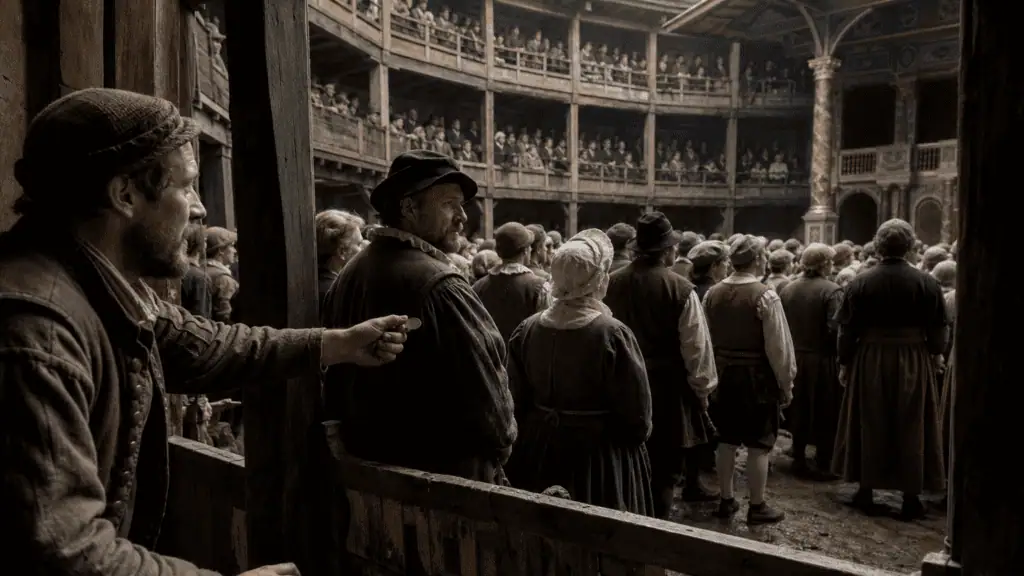
The price structure of the playhouse helps explain why. A spectator in the yard could stand for a penny, perhaps spending little more than the cost of a modest meal. Those with greater means could buy access to galleries or private rooms. The same play reached different people at different social levels. That did not erase inequality. On the contrary, the architecture made inequality visible. Yet it also created a rare kind of common experience. The poorest man in the yard and the gentleman in a gallery were not identical, but they were present at the same event and exposed to the same performance. In a city divided by status, that mattered.
This is where Elizabethan theatre becomes part of social history rather than literary history alone. A cheap admission fee helped regularise public culture. People did not attend because they had nothing better to do. They attended because theatre increasingly belonged to the way the city worked. It offered a place where the week could be interrupted by story, music, laughter, and argument. For apprentices whose lives were tightly regulated, for servants whose movement was watched, and for tradespeople who measured each expenditure carefully, the chance to enter such a space was meaningful.
The penny also changed expectations. Once the playhouse could rely on repeat attendance, performance became commercial, adaptive, and responsive. Companies needed audiences to return, and audiences learned that theatre might answer their appetite for novelty. This helped create a culture of habit around performance. The playhouse was no longer a one off diversion. It became a fixture in urban life, much like the market, the alehouse, or the church, though with a very different purpose. Its significance lies precisely there. It turned entertainment into a public practice that helped organise the experience of living in Elizabethan England.
London, Migration, and the Making of an Audience
A Growing City Hungry for Stories
Elizabethan London was one of the most restless cities in Europe. People arrived constantly, drawn by wages, apprenticeships, service, trade, or the hope of a better life than the one they had left behind. This migration gave the city a shifting population that was both unstable and energetic. Neighbours changed. Streets filled and emptied. New forms of work appeared alongside older ones. A city in motion needed ways for people to recognise themselves and one another, and theatre helped provide that.
The audience at the playhouse was not a refined literary public waiting for masterpieces. It was a mixed urban crowd shaped by the realities of late sixteenth century life. Some were long term residents of the city. Others were newcomers learning how to navigate its customs. Some could read easily. Others could not. Some came from households with money and influence. Others came with only a few coins and a hope for diversion. What united them was not education, but appetite. They wanted stories, spectacle, jokes, tragedy, and the thrill of seeing public life reflected back at them in heightened form.
This is why commercial drama grew so successfully in London. It spoke to a changing city that was still figuring out how to live with itself. Plays could draw on urban types, national anxieties, courtly manners, foreign threats, and domestic tensions because the audience itself was already heterogeneous. The commercial stage did not invent diversity. It responded to it. That response helped theatre become central to the cultural life of the capital and, by extension, to English memory.
The significance of this should not be underestimated. When a city becomes large and socially mixed, shared reference points matter. Theatre gave London one of those reference points. It created stories that could be discussed in taverns, workshops, households, and streets. It allowed strangers to laugh at the same joke and react to the same reversal. That shared responsiveness was itself a social achievement.
Readers, Non Readers, and the Reach of Performance
Book culture certainly mattered in Elizabethan England, but it did not reach everyone equally. Access to texts depended on money, schooling, and literacy. Even where books were available, reading was often private, slow, and limited to narrower circles. Spoken drama worked differently. It was immediate, collective, and public. An audience did not need to decode a page to understand a performance. They needed ears, attention, and the willingness to be drawn into a spoken world.
That made theatre unusually powerful. It carried ideas beyond the educated elite and into spaces where political, moral, and emotional questions could be encountered by people with little formal learning. A speech about loyalty, a comic exchange about marriage, or a scene of betrayal could be understood through listening and watching, even when the language was elevated or complex. Performance translated abstraction into experience.
This oral quality also made theatre communal. A book is often met alone. A play is encountered among others, and that changes interpretation. Laughter spreads. Silence deepens. Surprise becomes collective. In that sense, performance was not just a way of delivering text. It was a social form that helped make language part of public life. This is one reason the Elizabethan stage became so influential. It did not merely serve literature. It extended the reach of culture into the everyday world of Londoners who might never own a book but could still be moved by a spoken story.
Suspicion, Regulation, and the Space Between Control and Desire
Why Authorities Feared the Stage
The theatre never grew in a neutral environment. Civic and religious authorities watched it with suspicion. Protestant reformers often criticised performance as morally suspect, idle, or dangerously seductive. Their objections were not simply about taste. They belonged to a broader culture of discipline and concern about appearances, behaviour, and spiritual order. At the same time, city officials worried that large gatherings could produce disorder, theft, quarrelling, or the spread of disease. Crowds were always politically sensitive in Elizabethan England, and crowds at the theatre were no exception.
These fears were not imaginary. A packed public space did create opportunities for unruliness, and London authorities understood how quickly noise and movement could become hard to manage. There was also the issue of vice. Authorities linked public performance with gambling, prostitution, drunkenness, and other forms of urban loosening. Whether or not those associations were fair, they reveal how theatre sat inside a moral climate shaped by surveillance and anxiety.
Yet the stage was never fully suppressed because people wanted it too much. That is the crucial point. The same public that worried officials also filled the playhouses. The theatre could be condemned from pulpits and regulated from guild halls, but it remained attractive because it offered pleasure, novelty, and social contact. The tension between official disapproval and popular appetite helped define the entire institution. Theatre became a space where control was attempted but never complete.
The significance of this lies in the balance between fear and desire. Elizabethan theatre reveals a society that was not simply repressing popular culture or indulging it. It was negotiating with it. Public performance could be dangerous precisely because it gathered people together around words that might mean more than they seemed to mean. Authorities recognised that crowds listening to stories were crowds learning how to imagine. That made the stage harder to trust than a sermon, and harder to dismiss than mere amusement.
Theatres Beyond the City Walls
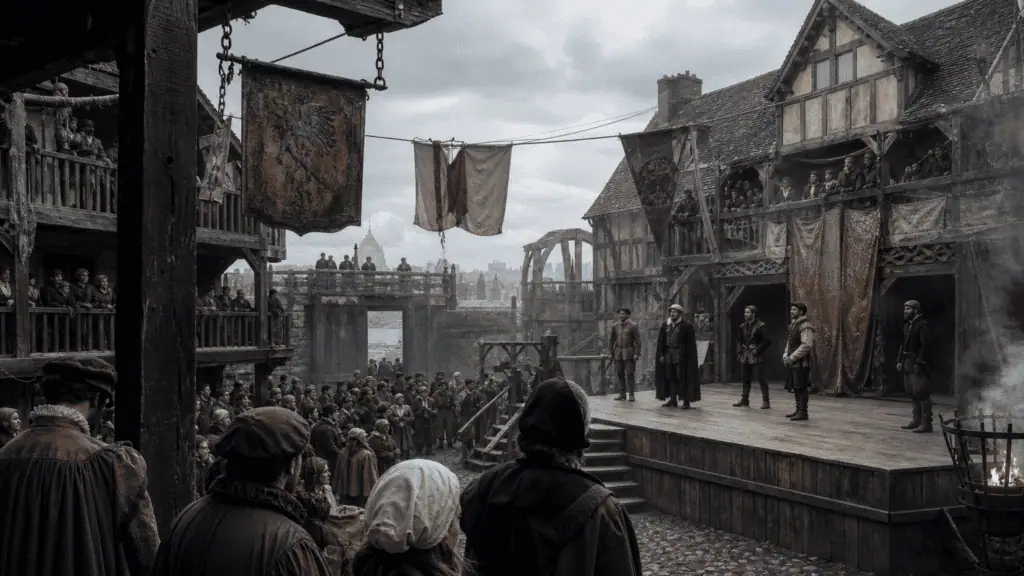
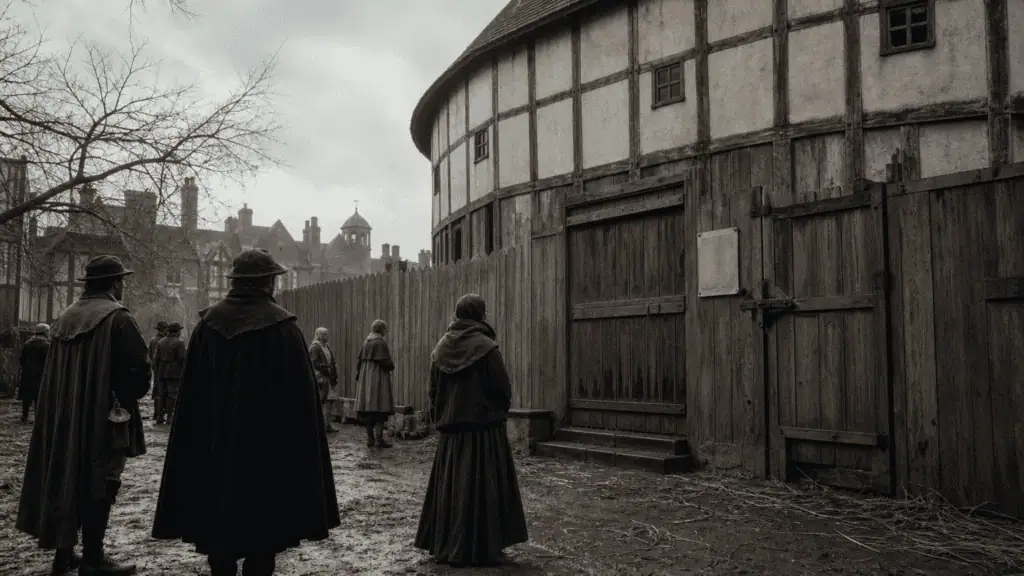
The geography of Elizabethan theatre tells us how negotiation worked in practice. Because London authorities were suspicious of playhouses within the city walls, many purpose built theatres appeared in areas just beyond direct civic control, such as Shoreditch and Southwark. This was not accidental. It was a spatial compromise shaped by regulation, commerce, and public demand.
By placing theatres beyond the city walls, companies could operate in places where local oversight was different and where urban visitors could still reach them easily. The Bankside in Southwark, especially, became an important performance zone because it combined accessibility with a certain legal and civic looseness. Cross the river, and the atmosphere changed. You entered a district associated with inns, bear gardens, theatres, taverns, and all the bustling energies that accompanied them. That location mattered. It placed performance in a place already familiar with mixed company and transient traffic.
This geography also created a symbolic boundary. To attend the theatre was to step into a different kind of civic space, one just outside the strictest forms of city governance. That did not make it lawless. It made it liminal. Theatres existed in the gap between official authority and public desire, and that gap was where a great deal of Elizabethan culture was formed.
Location shaped politics as much as architecture did. A playhouse outside the walls could be tolerated more easily than one in the heart of the city, but it was never beyond scrutiny. The authorities knew what gathered there. The audience knew it too. That shared awareness contributed to the theatre’s force. It was a place where people crossed physical and social boundaries in order to watch stories about power, identity, and change.
How the Playhouse Changed What an Audience Experienced
The Architecture of Shared Attention
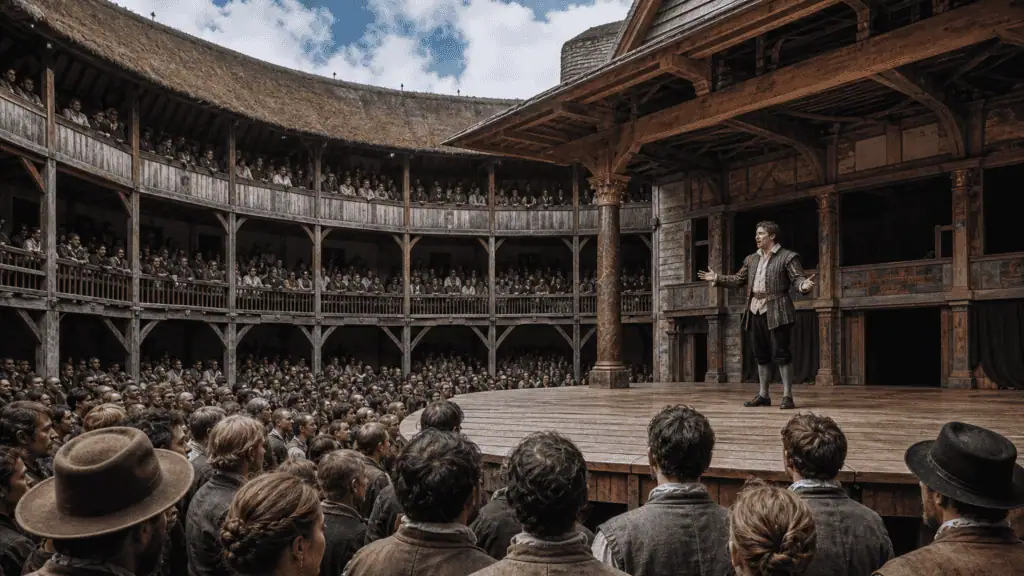
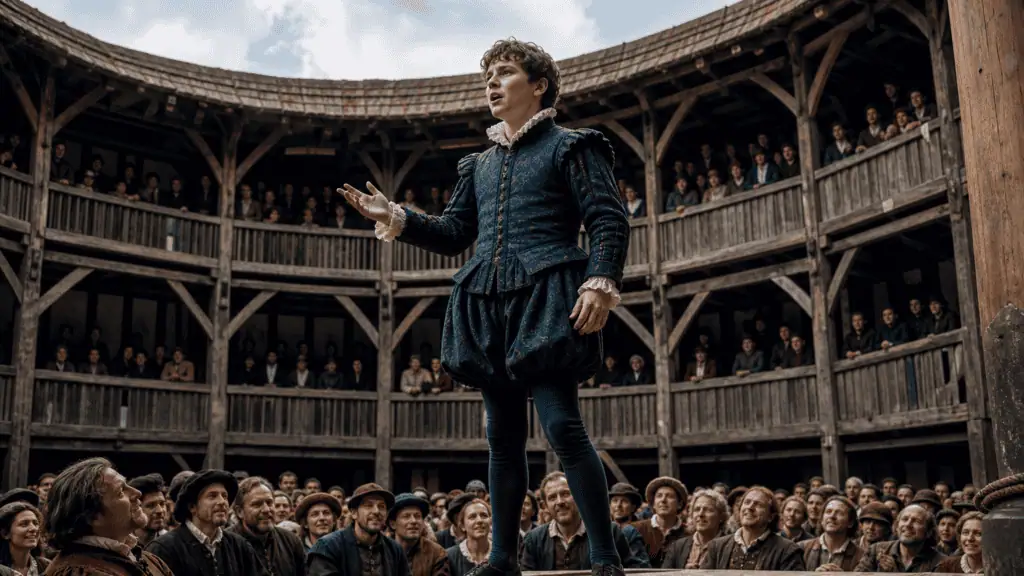
The purpose built playhouses of late sixteenth century London altered the experience of performance in practical and cultural ways. Buildings such as the Theatre, the Curtain, the Rose, and later the Globe were shaped to gather spectators around a central stage. Their circular or polygonal forms created a sense of enclosure without sealing the audience away from the outside world. Light, weather, noise, and movement remained part of the experience. The playhouse did not hide its physicality. It turned that physicality into part of the event.
This mattered because the audience was not passive. Spectators stood close to the action, often close enough to see the stage boards and hear the performance in its detail. They reacted openly. They commented, laughed, jeered, and judged. Their presence was felt by the actors, and the actors had to work with that awareness. A successful performance depended on the crowd taking part in the event through attention and response.
That kind of shared attention helped redefine public culture. It meant that theatre was not an art form delivered to silent consumers. It was a conversation between stage and yard, between performers and spectators, between script and response. The physical design of the playhouse reinforced that exchange. It made the audience visible to itself. People attending the theatre were not hidden away in darkness, as later audiences would be. They were part of the social theatre as much as the actors were.
This is one reason the Elizabethan playhouse mattered so deeply. It created a communal habit of interpretation. People learned to read gesture, costume, pace, and speech in front of one another. That habit trained them to respond collectively to public expression. In a society where public life was often hierarchical and guarded, the playhouse created a different form of shared attention, one that could cut across rank without abolishing it.
Language as Scenery
Elizabethan theatre did not rely on elaborate scenery in the modern sense. A spoken line could turn a bare stage into a forest, a prison, a battlefield, or a palace. Costume and gesture did much of the visual work. So did the imagination of the audience. This was not a weakness of the form. It was one of its strengths.
Because the stage offered limited physical decoration, language had to do more. A vivid speech could place a character in a world far larger than the boards beneath their feet. The audience participated in that transformation by imagining the setting into being. That required skill on both sides. Actors had to deliver lines with force and clarity. Spectators had to accept the invitation to picture what was not literally present.
This created a distinctive theatrical culture. Identity could appear fluid because the stage itself was a site of make believe and recognition. A character in disguise could remain visible to the audience while hidden from others on stage. A speech about kingship could make a small platform feel like a throne room. A sudden change in tone could shift the emotional landscape of the entire play. The audience understood that what they saw was constructed, but they also understood that its meanings were real.
That distinction is central to the importance of Elizabethan theatre. It taught people how fiction could reveal truth without pretending to be ordinary life. By making scenery out of language, it placed imaginative labour in the hands of everyone present. The crowd was not simply watching a world. It was helping to build it.
Performance, Identity, and the Role of Women on Stage
Boys Playing Queens and Lovers
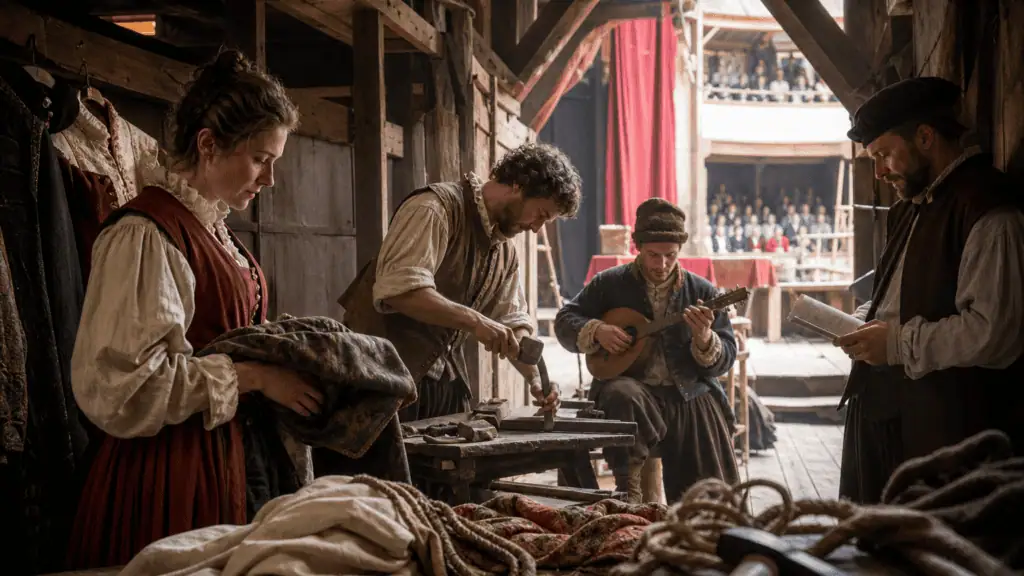
One of the most striking features of Elizabethan theatre was the use of boy actors in female roles. Because women were not permitted to perform professionally on the public stage, companies relied on boys to portray queens, maidens, wives, and lovers. This arrangement was partly practical, but it also had profound cultural effects.
To watch a boy perform as a woman was to encounter identity as something visibly constructed. The audience knew that the role was being enacted, yet the performance could still be emotionally convincing. That tension invited reflection. If a queen could be played by a boy, then gender on stage was not a simple expression of nature. It was a crafted presentation shaped by costume, voice, gesture, and convention. The stage exposed the performance within identity.
This did not mean that Elizabethan audiences were modern in their thinking. They remained deeply attached to social hierarchy and patriarchal assumptions. But the theatre still opened a space in which identity could appear unstable, layered, and dependent on outward signs. Disguise plots, mistaken identities, and role reversals were popular because they resonated with a broader culture in which reputation, clothing, and public conduct all mattered enormously.
That is why theatrical cross dressing and role play matter so much historically. They were not just tricks of casting. They reflected a society already concerned with how people were read in public. Who looked authoritative? Who seemed respectable? Who was taken seriously, and on what grounds? The stage turned those questions into entertainment, but it also made them visible. In doing so, it gave audiences a way to think about the roles they themselves were expected to perform in Elizabethan England and daily life.
Women in the Audience, Not on the Stage
Although women were excluded from professional performance, they were present in the audience. That fact should shape how we understand the theatre. Women did not stand outside this culture. They were part of it, observing its stories and responding to its representation of marriage, inheritance, obedience, desire, family conflict, and social judgement.
The gap between audience presence and stage exclusion is revealing. It shows how Elizabethan theatre could be socially inclusive in one sense and deeply unequal in another. Women could watch plays in which female lives were central, but they could not generally claim the same public role as performers. The stage gave them stories about agency without granting equal access to the act of speaking them aloud.
Even so, their presence mattered. Women in the audience encountered dramas that explored the pressures placed upon them by law, custom, and household authority. They watched comedies that mocked courtship and tragedies that exposed the dangers of confinement, suspicion, or forced obedience. The theatre did not solve these tensions, but it brought them into public view.
This is one of the reasons the playhouse mattered beyond entertainment. It made social tensions visible without requiring formal argument. A woman watching a marriage plot or a scene of betrayal did not simply consume amusement. She participated in a public culture that reflected the instability and negotiation built into gendered life. The playhouse therefore became a place where the boundaries of social identity could be seen, even when they could not be fully crossed.
Theatre as an Industry of Many Hands
The Workers Behind the Famous Names
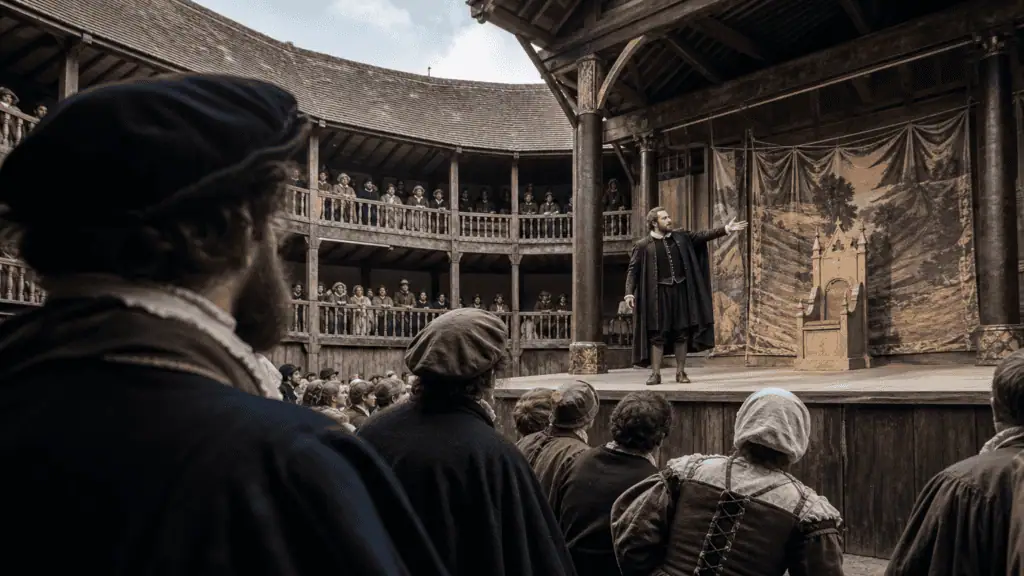
The mythology of Elizabethan theatre often narrows the past to a few celebrated playwrights. That story is too small. A theatre company depended on actors, musicians, stagekeepers, seamstresses, carpenters, bookkeepers, copyists, messengers, and sellers who worked at the doors and within the wider performance economy. Each play that survived on paper once passed through many hands.
This matters because the theatre was not simply a literary achievement. It was an industry. Costumes had to be made and maintained. The stage had to be repaired. Money had to be counted. Lines had to be copied and delivered. Props had to be organised. Audiences had to be admitted and managed. Performance was a collaborative labour that required coordination and repetition.
The social history of this labour is just as important as the literary history of the plays themselves. Many of the people who sustained the theatrical world left little trace in the record. Their names did not become famous, yet the survival of performance depended on them. To focus only on the writer is to miss the economic and practical conditions that made theatrical culture possible.
This broader view also helps rebalance our understanding of Elizabethan culture. The stage did not rise because a solitary genius spoke and the world listened. It rose because a system of work existed around the spoken word. That system linked the glamour of performance to the ordinary realities of payment, transport, sewing, carpentry, and bookkeeping. In that sense, the theatre was a mirror of London itself, where visible splendour depended on invisible labour.
Companies, Investors, and Survival
Acting companies had to survive in a marketplace that was never secure. They needed patronage, investors, and regular audiences. They also faced illness, financial uncertainty, and the constant risk of interruption. Plague could close playhouses. Disputes within companies could weaken them. A bad season could leave a company struggling to pay its way. Theatre was therefore an art form shaped by risk as much as by talent.
The business arrangements behind the stage mattered because they determined what could happen on it. Patronage gave companies protection and status, but it also created obligations. Investors expected returns. Performers needed income. If audiences did not come, the whole arrangement faltered. This made the theatrical world remarkably responsive to public taste. Companies could not simply produce what they liked. They had to understand what the crowd would return to see.
That commercial pressure helped drive creativity, but it also exposed the fragility of the entire enterprise. A playhouse was not a permanent monument. It was a precarious machine built to gather attention for as long as circumstances allowed. Its success depended on cooperation between art and enterprise. That combination is part of what made Elizabethan theatre so distinctive. It was not protected from the market, nor wholly governed by it. It existed in a lively tension between artistic ambition and practical survival.
Pleasure, Feeling, and the Power of Drama
Why Entertainment Was Serious
It is tempting to dismiss the pleasures of theatre as light relief from harder historical realities. That would be a mistake. For people living in a world shaped by labour, discipline, hierarchy, uncertainty, and periodic crisis, the chance to laugh, gasp, and be moved carried genuine social weight. Pleasure was not a luxury added on top of life. It was one of the ways people endured life.
This is especially true in a culture where so much depended on restraint. Public conduct was regulated. Speech was watched. Behaviour in households, apprenticeships, and civic spaces was judged closely. Theatre offered a controlled release of feeling. It let people encounter danger, desire, conflict, and reversal in a setting that could hold those emotions safely for a few hours. That safety did not make the experience trivial. It made it usable.
A comedy could release tension around marriage or class. A tragedy could expose the cost of ambition or betrayal. A history play could make political anxieties emotionally legible. In each case, the audience was not merely being entertained. It was being invited to feel with structure and purpose. The result was a form of public emotion that helped organise how people thought about themselves and their society.
This is why the theatre mattered more than entertainment. It provided an arena in which feeling itself became historical. People learned what it was like to sympathise with rulers, outsiders, lovers, rebels, or the wronged. They also learned how quickly those sympathies could be complicated. The playhouse did not preach at the audience. It made them experience the instability of the world through story.
Ideas Carried Through Story
Plays could address fear, loneliness, danger, authority, and social change without sounding like formal argument. That is one of the great strengths of drama. A person might sit down expecting amusement and leave having felt the strain of power or the vulnerability of an outsider. Fiction made that possible because it allowed difficult truths to be encountered indirectly.
In Elizabethan England, where public speech could be restricted and political meaning closely monitored, drama offered a flexible form of expression. It could explore rebellion, religious unease, gender expectations, and the fragility of rank while remaining artful enough to avoid direct accusation. The audience knew how to read this. They were not passive recipients of moral instruction. They were skilled interpreters who brought their own experiences to the stage.
That interpretive freedom helped drama travel beyond the moment of performance. A play could leave behind more than amusement. It could leave a phrase, a memory, or a sharpened sense of the world. The theatre was powerful because it communicated through feeling as well as argument. It turned ideas into lived experience for the length of an afternoon, and sometimes longer in the minds of those who watched.
Theatre and Power in Elizabethan England
Patronage and Royal Image
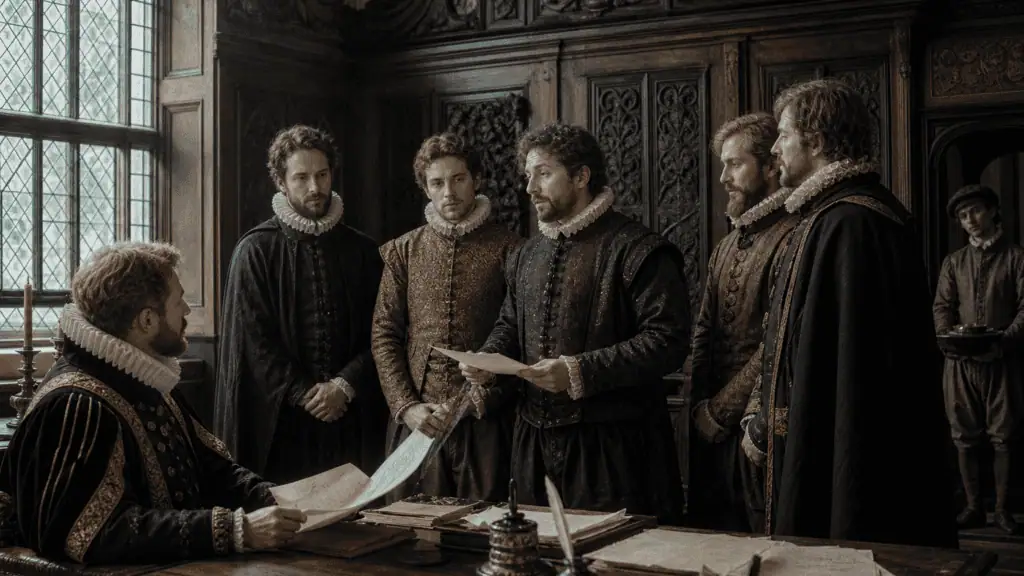
The relationship between theatre and power was never simple. Acting companies relied on noble patrons, whose names and protection gave them legitimacy. Patronage linked performers to networks of status and obligation. A company connected to the royal court might gain prestige, but it also entered a political world where image mattered deeply.
Queen Elizabeth understood spectacle. Her reign was marked by ceremony, careful self presentation, and a strong awareness of public image. Theatre sat within that same culture of managed visibility. It could support the authority of the monarchy by dramatising order, legitimacy, and providence. Yet it could also complicate those themes by showing how fragile authority actually was when placed under pressure.
This is why the stage attracted so much official attention. A play was never merely a play in political terms. It could be read as a warning, an allegory, or a subtle commentary on current anxieties. Licensing and censorship existed because those possibilities were real. The state knew that performance could circulate meanings without naming them outright.
At the same time, patronage did not make the theatre obedient in any simple sense. It gave protection, not complete control. Companies still had to satisfy audiences, and audiences brought their own expectations to every performance. The result was a public culture in which theatre could both serve authority and expose the uncertainties that surrounded it. That ambiguity was not a weakness. It was the source of its reach.
Ambiguity as Strength
Elizabethan theatre could explore unstable or controversial subjects because it rarely had to speak in direct and simple terms. A drama about a troubled king might echo contemporary concerns without explicitly naming the present ruler. A comedy about family conflict could reflect on obedience, property, and marriage while remaining formally playful. A tragedy might illuminate the human cost of political decision making without making a manifesto.
This ambiguity made the stage unusually resilient. It could entertain, flatter, unsettle, and provoke at the same time. Authorities watched it because they feared what it might mean. Audiences returned because they enjoyed exactly that mixture of meanings. The playhouse therefore became one of the few places where a broad public could collectively encounter complexity in real time.
That should change how we understand the culture of Elizabethan England and daily life. The theatre was not separate from power. It was one of the spaces where power was imagined, tested, and felt. Its importance lay in that tension. It allowed a society built on hierarchy to see itself from within and to do so through performance.
Conclusion
It is easy to begin and end the story of Elizabethan theatre with famous names. Shakespeare dominates the memory, as he deserves in literary terms, but that memory is incomplete. If we look more closely, the deeper history begins with a boat landing on the south bank, with mud on shoes, with the smell of river weed and hot meat, with the sound of arriving crowds, and with the small act of paying a penny to enter a shared world. That is where the real significance lies. The theatre was not simply a building in which masterpieces were performed. It was a social invention that depended on movement, expectation, labour, and public attention.
What made it matter so much was its ability to gather different kinds of people into the same moment without pretending that their lives were equal. Labourers stood beside traders. Servants heard the same speeches as gentry. Women watched stories that shaped the rules of their own lives while remaining excluded from the professional stage. Apprentices, sailors, householders, and visitors all took part in the same act of interpretation. The playhouse turned a diverse city into an audience and, in doing so, created one of the most powerful forms of public culture in Elizabethan England.
That power reached beyond amusement. Theatre changed how ideas moved. It gave people without books access to arguments about authority, marriage, loyalty, ambition, and loss. It made emotional experience communal. It allowed fiction to carry truths that direct speech might not safely hold. It also revealed how much performance relied on ordinary labour, from the people sewing costumes to those managing the doors, counting the money, and hauling timber. When we remember only the surviving texts, we miss the conditions that made those texts audible at all.
The significance of Elizabethan theatre, then, lies not in greatness alone, but in collectivity. It showed that culture is built by audiences as much as authors, by workers as much as celebrated writers, and by the spaces in between official control and public desire. That is why this history still matters. The stage was a place where ordinary people helped shape the public imagination of a nation.
If you would like to continue uncovering the lives hidden beneath famous names, explore more Digging Deep Histories articles on Elizabethan England and daily life, Shakespeare and the wider Elizabethan stage, the social history of London in the sixteenth century, Women in Tudor and Elizabethan society, and the history of Southwark and the Bankside theatres.