

On 5 March 1770, in Boston, a crowd gathered in the cold and uncertain light of late winter. Snowmelt had begun to run through King Street in dirty streams. The air carried the mingled smells of coal smoke, horse dung, and the harbour. A lone sentry stood outside the Custom House, surrounded by men who were not actors in a grand political drama, but dock workers, sailors, apprentices, and shopkeepers who had reached the end of their patience. Then came the insults, the thrown objects, the shouted accusations, the raised musket, and the gunfire that left five civilians dead.
That moment became famous because it seemed to capture a simple story of oppression and resistance. But the truth is larger and more revealing. The American Revolution did not begin with a neat declaration of national purpose. It emerged from a strained imperial system that linked Britain, North America, the Caribbean, Africa, and Europe through commerce, credit, war, and coercion. The Boston crowd was reacting not only to soldiers on one street, but to years of mounting tension over taxation, authority, trade regulation, and the place of colonial assemblies within the British Empire.
That wider setting matters because it changes the meaning of the revolution itself. This was not merely a quarrel between Britain and thirteen colonies. It was a conflict about who had the right to govern in an age of expanding trade and imperial rivalry. It was also a struggle shaped by slavery, Indigenous dispossession, and the circulation of political language across the Atlantic world. If we keep our focus too narrowly on patriotic rhetoric, we miss the deeper significance of the event. The American Revolution mattered because it forced old powers to defend themselves in a world of rising costs, fragile authority, and increasingly connected populations. It altered empire, inspired revolution, exposed contradictions, and helped create the political language of the modern Atlantic world. The familiar story is only the surface. The larger story is about systems under strain.
What follows is the story of the American Revolution with Marcus Langston.

Boston, 5 March 1770, and the spark of unrest
The King Street crowd as a sign of deeper strain
The confrontation on King Street did not happen in a vacuum. Boston in early March was a port town living under pressure. Its economy depended on shipping, labour, and seasonal movement, and those rhythms were disturbed by the presence of British troops stationed among the population. For years, colonists had argued that Parliament in London was tightening control over trade and taxation without respecting local rights. The result was a city where political grievance seeped into daily life. Every argument over employment, every dispute at the docks, every rumour in a tavern could be folded into a larger complaint about imperial power.
That is why the crowd mattered so much. It was not a disciplined army of revolutionaries, nor a mob acting from nowhere. It was a mixed public, assembled out of ordinary urban life, and brought together by resentment that had accumulated over time. The sentry outside the Custom House symbolised the presence of authority, but he also represented something more unsettling. To many Bostonians, soldiers in peacetime looked like a warning that the Empire was willing to enforce obedience at gunpoint. The confrontation therefore became a visible edge of a wider crisis. Britain was trying to maintain order in an empire stretched across oceans. Colonists were asking why order seemed to require surveillance, taxation, and armed men in their streets.
The eruption of violence on King Street was important not because it began the Revolution, but because it revealed the mood that made revolution possible. It showed how imperial conflict was entering the daily experience of ordinary people. The grievance was not abstract. It was felt in the body, in the street, in the cold air, and in the fear that redcoats had become part of the local landscape. That is where the deeper story begins.
Why the Boston Massacre image travelled so far
The deaths in Boston quickly became more than a local tragedy. They were transformed into political evidence. In the eighteenth century Atlantic world, printed images, pamphlets, newspapers, and letters could carry a single event across vast distances with remarkable speed. A confrontation on one street in Massachusetts could be recast as proof of British tyranny in Philadelphia, Charleston, London, and beyond. This was not simply the spread of information. It was the creation of meaning.
Colonial leaders understood that outrage could be organised. The Boston Massacre, as the event came to be called, provided a vivid image that could be repeated and remembered. It allowed critics of imperial policy to present British troops not as protectors of order, but as instruments of intimidation. That interpretation mattered because politics in the late eighteenth century depended increasingly on persuasion, print, and public reputation. The episode therefore moved from event to argument, and from argument to symbol. It became part of a shared colonial grievance that linked one town to broader discontent across North America.
Yet the image travelled even further because it touched a nerve within the imperial system itself. Britain and its colonies were already in dispute over authority, and now the violence in Boston offered each side a story about the other. To colonists, it demonstrated that a distant government would use force against subjects who insisted on their rights. To imperial officials, it suggested that colonial unrest could become dangerous and contagious. The massacre therefore did not merely inflame protest. It helped create the political atmosphere in which every further dispute would be read through suspicion. That is one reason the American Revolution mattered far beyond Boston. It showed how quickly a local event could become part of a transatlantic struggle over legitimacy.

An empire under strain after 1763
Britain’s victory and growing debts
The broader crisis began with Britain’s victory in the Seven Years’ War, concluded in 1763. That war had made Britain the strongest imperial power in North America, but victory came at a price. The state emerged burdened by heavy debt, and the cost of defending an expanding empire remained immense. British ministers believed, with some justification, that the colonies ought to help shoulder that burden. Colonial settlers had benefited from imperial protection, from naval power, and from the commercial opportunities created by British victory. From London’s perspective, a modest contribution from the colonies was reasonable.
The problem was that imperial victory altered expectations on both sides. Britain saw a costly empire that needed better management. Many colonists saw a moment to defend their existing autonomy. The postwar settlement therefore sharpened old disagreements about authority. London increasingly treated the colonies as parts of a coordinated system, subject to regulation and fiscal pressure. Colonial assemblies, by contrast, had grown accustomed to managing their own internal affairs. They had tax traditions, local political habits, and a powerful sense that legitimacy was bound up with elected representation.
This was not simply a financial question. It was a constitutional question set inside a wider Atlantic framework. Britain had to defend territory, manage trade, and protect commercial routes that stretched from North America to the Caribbean and across the ocean to Europe. Debt made that system fragile. Revenue became a test of imperial strength. Once money was linked to authority, every colonial refusal looked like a challenge to sovereignty. Once the colonies resisted, London began to fear that any concession would weaken imperial discipline elsewhere. The post 1763 settlement, then, was never just about recovery from war. It was the moment when the imperial centre began to demand that subjects pay for the system that governed them.
Representation, authority, and colonial resistance
Colonial resistance took shape in the familiar language of no taxation without representation, but that phrase carried a deeper constitutional claim. Colonists argued that only bodies directly accountable to them could authorise internal revenue. Parliament, sitting an ocean away, might legislate for the empire, but taxation without local consent seemed to break an older understanding of liberty. In this argument, rights were not abstract slogans. They were tied to institutions, precedent, and the practical habits of political life.
What makes the dispute so significant is that both sides claimed to be defending order. Parliament insisted that it possessed sovereign authority across the empire. Colonial critics insisted that representative government could not survive if revenue were imposed from above. The disagreement was therefore not about policy alone. It was a fight over where power genuinely lay. If Parliament could tax the colonies at will, then imperial authority was broader than colonial assemblies had ever accepted. If colonial assemblies could veto revenue, then imperial sovereignty was weaker than British ministers believed.
This clash mattered because it exposed the instability of empire itself. Empires function not only through armies and ships, but through consent, routine, and the appearance of settled authority. Once colonists began to question who could authorise taxation, they also began to question the wider structure of rule. And once London answered with coercion, the disagreement became harder to contain. The American Revolution mattered because it showed that constitutional arguments could become imperial crises when they were tied to money, military force, and public politics. A quarrel over who had the right to tax became a dispute over who had the right to rule.

Trade, taxation, and the Atlantic economy
Sugar, shipping, and credit across the Atlantic
To understand why these disputes escalated so quickly, we need to follow the goods. An eighteenth century Atlantic economy linked plantations, ports, merchants, insurers, creditors, and soldiers into one vast commercial system. Sugar from the Caribbean was not just a luxury. It was the product of plantations worked by enslaved Africans, transported by ships, financed through credit, and protected by naval power. Its profits sustained merchants in London and generated influence in political circles. Similar connections bound North American commerce to imperial routes. Timber, fish, rum, grain, and provisions moved alongside manufactured goods and credit instruments that depended on trust across distance.
The colonies were therefore not isolated communities waiting to become a nation. They were active parts of a commercial empire. That fact explains why taxation and regulation provoked such intense anxiety. Any new duty, any tightened rule, any altered commercial arrangement could disrupt business networks that already depended on precarious margins. Merchants feared lost profits. Traders feared interference with established practices. Coastal communities feared that imperial policy would favour metropolitan interests over colonial ones.
This is also why resistance became social as well as political. Men and women who did not think of themselves as constitutional theorists still understood the daily effects of credit and trade. A boycott changed what could be purchased. A shipping delay altered wages. A customs rule affected food, clothing, and household consumption. The empire was felt in kitchens and counting houses as much as in legislatures. The American Revolution matters because it reveals how power works through commerce. The conflict was never just about ideas. It was about the material architecture of Atlantic exchange, and about who would profit from it.
The problem of being governed from afar
For many colonists, the deepest frustration lay in distance. Parliament could alter the rules, but colonial subjects lived with the consequences. This is the practical heart of the constitutional crisis. Being governed from afar meant that decisions could be made by men who did not share the same local pressures, and who were answerable to interests that were not colonial interests. The Sugar Act, the Stamp Act, and the Townshend duties were therefore more than separate measures. Together they suggested a dangerous principle: that authority could be extended, refined, and enforced without meaningful consent.
Each measure seemed to confirm the next. The Sugar Act signalled a sharper approach to customs and trade. The Stamp Act reached into everyday transactions and legal documents. The Townshend duties connected imperial revenue to colonial consumption. Taken together, these laws made the empire feel less like a partnership and more like a hierarchy. Colonists worried not only about what was being taxed, but about what taxation implied. If Parliament could reach into local economic life without colonial approval, then what else could it do? Could it rewrite commercial expectations, alter legal traditions, or impose policy in matters once left to local control?
That uncertainty is why taxation became symbolic. A duty on paper or tea could stand for the uncertainty of imperial authority as a whole. In the late eighteenth century Atlantic world, symbol and structure were inseparable. The colonists’ anger came from the feeling that the rules of the game were changing without their participation. Their resistance therefore expressed more than economic self interest. It reflected a profound fear that a distant empire was becoming a more intrusive state. The revolution mattered because it turned that fear into a political movement.

Resistance, protest, and contradiction
Boycotts, petitions, and crowd action
Resistance was broad, inventive, and often disciplined. Colonists did not simply riot, although crowd action certainly played a role. They petitioned, wrote, boycotted, argued in print, and built local and intercolonial networks of protest. Merchants negotiated collective agreements to reduce imports. Printers turned legal disputes into public controversies. Women shaped the movement through household purchasing choices, especially when boycotts required communities to decide what they would not buy, wear, or drink. Political clubs and committees helped spread coordination from one colony to another.
This mattered because it showed that opposition to empire was not confined to elite men in assemblies. It moved through ordinary institutions and everyday behaviour. The politics of resistance entered kitchens, workshops, shipyards, and taverns. A boycott could be as politically significant as a speech. A printed essay could travel further than a governor’s proclamation. The Revolution depended on these forms of mobilisation long before independence was declared.
The movement also became increasingly connected across the colonies. One of the most important developments of the period was the sense that resistance in Boston was linked to grievances elsewhere. This did not mean that all colonists agreed on every issue. They did not. But the circulation of texts, rumours, and commercial pressure made imperial conflict feel shared. That was a major step towards revolution. Political cooperation expanded faster than imperial management could respond. The result was a widening gap between colonial mobilisation and British control. The revolution mattered because it demonstrated how collective action could grow out of dispersed local grievances when people recognised that their problems were part of the same system.
Liberty and unfreedom in the same political culture
The language of liberty gave the movement its force, but it also exposed its contradictions. Many colonists who condemned British power continued to enslave other people. Some who defended their own rights also pursued Indigenous lands. These were not side issues. They were central to the revolutionary era. A society that claimed liberty while profiting from unfreedom was already structured by contradiction, and the Revolution did not remove that contradiction. In some cases, it deepened it.
That tension is one reason the American Revolution should be treated as part of a wider Atlantic history rather than as a simple national origin story. The colonies were embedded in systems of slavery, commerce, and territorial expansion. Political language could be radical while social practice remained highly unequal. The same men who demanded freedom from Parliament could deny freedom to others. The same communities that celebrated rights could support dispossession. This did not make revolutionary ideas meaningless. It made them contested. Their power lay partly in their universality, but their limits were visible from the beginning.
This contradiction shaped the revolution’s legacy. It affected who could claim the language of rights and who was left outside it. It also influenced how outsiders interpreted the American cause. To some, the revolution offered a new vocabulary of political legitimacy. To others, it looked like a rebellion that preserved hierarchy under a different flag. The truth contains both readings. The American Revolution mattered because it broadened political language while leaving many structures of domination intact. That combination would shape the Atlantic world long after 1783.
From protest to war
Tea, punishment, and failed compromise
The Boston Tea Party was not simply an outburst of anger. It was a carefully chosen act of defiance directed at the meaning of imperial taxation. The East India Company had been granted special advantages in the tea trade, and British ministers saw the measure as a way to preserve commerce and support a troubled corporation. Colonial critics saw something else entirely. To them, it looked like a device to make acceptance of parliamentary authority inevitable. Tea was not only a commodity. It was a test case.
London’s response, the Coercive Acts, was meant to restore order and isolate Massachusetts. Instead, the punishment widened the political crisis. By closing Boston’s port and limiting local self government, Britain convinced many colonists that the issue was not a single town’s misconduct, but a dangerous imperial precedent. What happened in Massachusetts could happen elsewhere. That fear encouraged cooperation rather than compliance.
The First Continental Congress in Philadelphia in 1774 was the result. Delegates did not meet because the colonies had already become independent. They met because they still hoped to defend their rights within the empire while presenting a united front. That distinction matters. The Revolution did not begin as a unanimous drive for separation. It moved there through escalating misunderstanding, punitive policy, and the failure of compromise. The American Revolution matters in part because it shows how imperial governments can make conflict worse when they mistake coercion for control. The more Britain tried to isolate resistance, the more it created shared colonial purpose.
Lexington, Concord, and the narrowing path to peace
By April 1775, the conflict had passed from political contest into open war. Fighting at Lexington and Concord showed that the empire could no longer rely on negotiation alone. Yet even then, many colonists still imagined reconciliation. That hesitation is important. War did not instantly erase imperial loyalty. Rather, it made clear that both sides had entered a phase in which trust was rapidly disappearing.
The path to peace narrowed because institutions could not contain the conflict. Parliamentary authority, colonial assemblies, armed forces, and popular mobilisation all pulled in different directions. Once blood was shed, each side could point to the other as the source of breakdown. Every military move could be interpreted as proof of hostile intention. Once that happened, the logic of compromise weakened. In such a climate, political language hardened into revolutionary commitment.
This is one of the most important lessons of the American Revolution. Wars do not begin only when someone decides to fight. They begin when systems fail to absorb disagreement, and when arguments that might once have been managed within a constitutional order become irreconcilable. Lexington and Concord marked the point at which that failure became visible. From there, the movement toward independence accelerated, not because all colonists had become ideologues, but because events had made old arrangements increasingly impossible to sustain. The Revolution mattered because it revealed how quickly an empire could lose control once its authority no longer seemed credible.

Declaration, rights, and exclusions
Independence and the language of universal rights
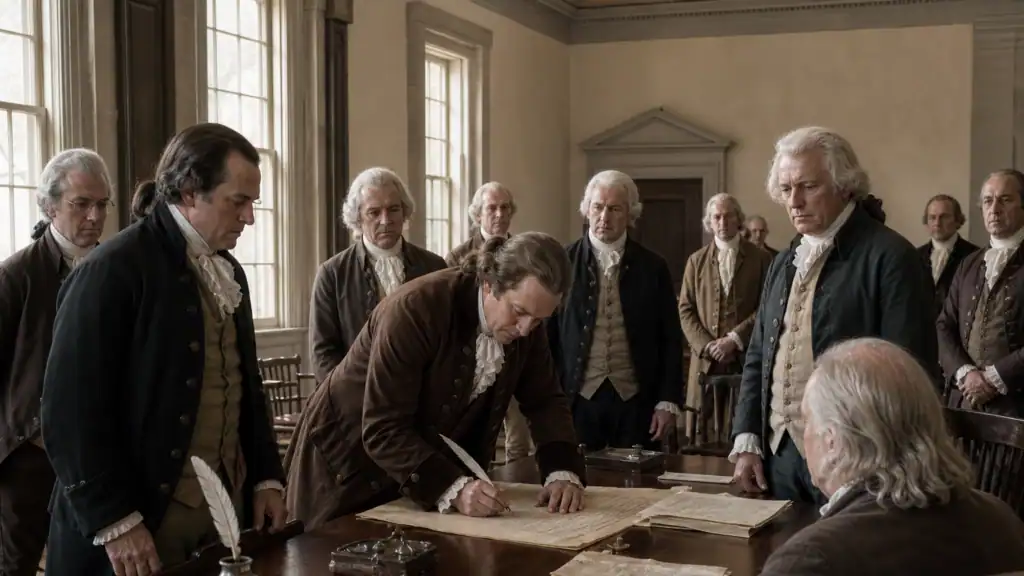
When the Continental Congress declared independence in July 1776, it did more than announce a break with Britain. It wrote a political argument designed for a world that was already listening. The Declaration of Independence framed the crisis as one of natural rights, legitimate government, and the consent of the governed. Its language was universal in form, even if its authors were bound to a particular political emergency. A people, it argued, could reject a ruler who violated its liberties.
That mattered because it made the American cause intelligible beyond the colonies. The declaration could be read as a defence of rebellion, a model of political legitimacy, or a warning to monarchies and empires elsewhere. It turned a colonial war into a statement about sovereignty itself. In the late eighteenth century Atlantic world, that was a powerful transformation. Political legitimacy was no longer being defended solely through inheritance, empire, or conquest. It was being recast in the language of rights and public consent.
We should not overstate the immediacy of this change. Many people rejected the declaration’s claims, and many others judged them hypocritical. Still, the force of the document lay in the fact that it created a new standard by which rulers could be judged. Future reformers, revolutionaries, and critics would return to its words, sometimes to honour them, sometimes to expose their limits. That is why the American Revolution mattered more than a change of flags. It altered the terms on which political authority could be discussed.
The limits of revolutionary equality
The revolution’s language was expansive, but its practice was limited. Enslaved people remained property in most of the new states after independence was declared. Women were excluded from formal political power. Indigenous nations were treated not as sovereign partners, but as obstacles to settlement and expansion. These facts are not footnotes. They define the reach of revolutionary change.
The gap between ideals and reality was not accidental. It was built into the society that made revolution possible. Colonists could invoke liberty while preserving slavery because the economy, social hierarchy, and territorial ambitions of the colonies made such contradictions normal. Independence did not erase that pattern. In some respects, it gave it new forms. The new republic inherited imperial habits of expansion even as it denounced imperial rule.
That is why we must read the Revolution with care. The language of equality mattered because it established a future political claim that others could seize. But the limits of equality also mattered because they showed how revolutionary language could coexist with exclusion. The American Revolution therefore produced not a clean resolution, but a set of tensions that continued to shape political life in the Atlantic world. It opened the door to broader debate while leaving many people outside the room. That unresolved tension is part of its historical significance.
The war becomes a global conflict
France, Spain, and the expansion of war
The war changed once France entered the conflict in 1778. French support brought loans, weapons, soldiers, engineers, and naval power. Spain soon joined the war against Britain, and the Dutch Republic became involved later. What had begun as a rebellion in North America was now a wider contest for imperial advantage. Fighting spread across the Caribbean, West Africa, the Mediterranean, and the Indian Ocean world. The American theatre remained important, but it was only one part of a far larger struggle.
This internationalisation was not accidental. France wanted revenge and strategic advantage after earlier losses to Britain. Spain sought to weaken a rival while securing its own imperial interests. Britain now had to defend trade routes and distant possessions while trying to defeat an increasingly resilient rebellion. In this context, the conflict became a test of imperial overstretch. The question was not simply whether Britain could win battles in North America. It was whether it could sustain power across a global commercial and military system while fighting multiple enemies.
The Caribbean was especially significant because sugar colonies produced immense wealth. A naval campaign there could have economic consequences beyond the scale of many land battles. Shipping, insurance, and credit all responded to risk. Decisions made in European capitals were shaped by the movement of fleets and the vulnerability of plantations. The American Revolution matters here because it reveals the hidden geography of war. Independence was won not only on the mainland, but through the pressure placed on a global empire whose resources were never infinite.
Yorktown and the limits of British power
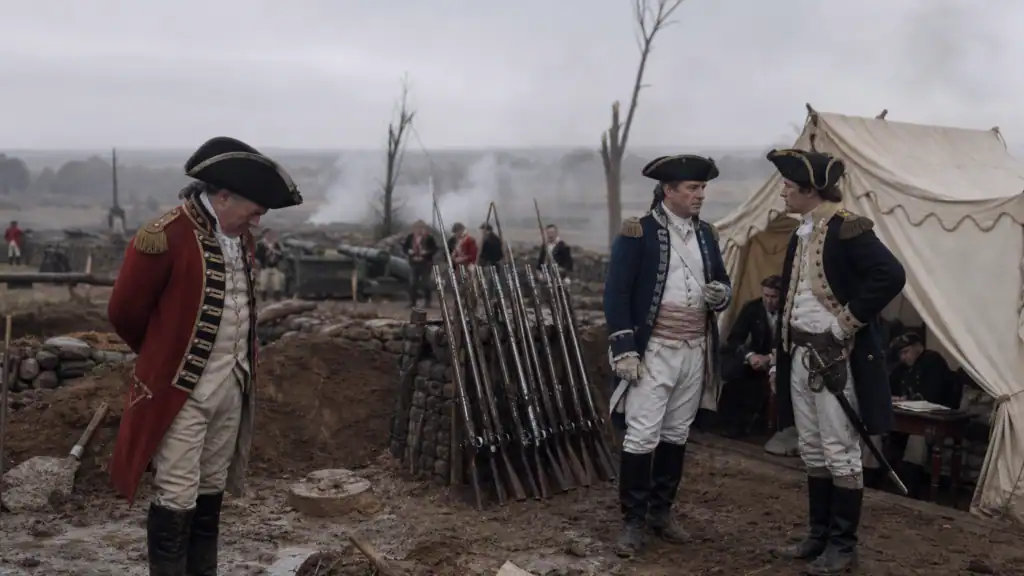
Yorktown in 1781 was decisive because it exposed those limits. French naval intervention helped prevent British relief and trapped Cornwallis’s army. The surrender that followed did not instantly end the war, but it made the outcome unmistakable. British power had reached the edge of its capacity. The empire could project force across oceans, but not without vulnerability. Once the French fleet controlled the strategic space around Yorktown, the British position became unsustainable.
That does not mean local resistance was unimportant. It was essential. American mobilisation, endurance, and political organisation kept the rebellion alive long enough for foreign intervention to matter. But Yorktown shows that independence was secured through global pressure, not local action alone. The revolution was successful because a colonial rebellion intersected with the interests of other imperial powers. Britain was fighting a war on too many fronts.
This was the broader meaning of the conflict. It demonstrated that empire was vulnerable when rivals could exploit its commitments. It also showed that the Atlantic world was no longer governed by one dominant power. In the late eighteenth century, war, trade, and diplomacy were becoming increasingly interconnected. The American Revolution mattered because it helped reveal that reality. It did not simply break Britain’s colonial hold. It exposed the structural weakness of imperial systems that depended on constant expansion while facing constant resistance.
Revolutionary ripple effects beyond America
The peace settlement and its wider audience
The Treaty of Paris in 1783 recognised the United States, but the settlement reached far beyond one peace agreement. It altered the balance of Atlantic politics and gave reformers a new example of political possibility. A former set of colonies had become an independent state. That fact alone was destabilising. It suggested that imperial authority was not permanent and that political legitimacy could be challenged successfully by subjects who organised effectively and secured allies.
The new republic quickly became part of wider debates about sovereignty, constitutions, and the relationship between rulers and the ruled. Its written declaration and later constitutional arrangements were studied, criticised, and adapted in other settings. People did not all admire the American example, but they could not ignore it. It became a reference point for those arguing that government should rest on consent rather than inherited authority. At the same time, critics pointed to slavery, expansion, and elite power as proof that republican language did not guarantee just outcomes.
This dual effect is central to the Revolution’s significance. It generated both hope and scepticism. It offered a model and a warning. The lesson for the Atlantic world was not that America had solved the problem of political order, but that old forms of authority could be challenged and replaced. That changed what was thinkable. Once a rebellion had succeeded, others could imagine doing the same. The American Revolution mattered because it altered the political imagination of an age already under strain.
Haiti, empire, and the politics of freedom
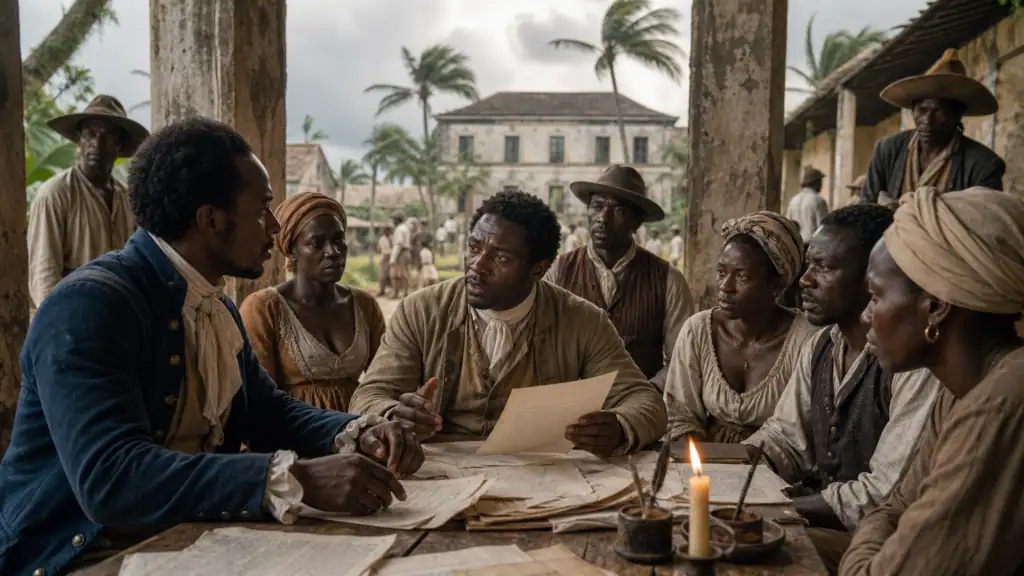
The influence of the American Revolution on the wider Atlantic world is most striking when we look to Saint Domingue, the French colony whose wealth rested on enslaved labour. The Haitian Revolution began in 1791 and was shaped in part by the language of rights circulating after 1776. But it was not a copy of the American struggle. It was a revolution driven by enslaved people themselves, pursuing freedom on their own terms and reshaping Atlantic history in the process.
That distinction matters. The Haitian Revolution shows that revolutionary language could escape the control of the people who first popularised it. Once rights were spoken aloud in the Atlantic world, they could be claimed by those excluded from them. Enslaved men and women, free people of colour, imperial officials, and armed revolutionaries all entered the argument with different aims. The American example had unsettled old assumptions. Haiti showed that the consequences of that unsettling could be far more radical than many contemporaries imagined.
The American Revolution also unsettled imperial subjects elsewhere. It demonstrated that European power could be defeated, especially when rival empires intervened. Yet it also intensified anxiety among slaveholders and colonial administrators, who feared similar challenges to authority. This is why the revolutionary age should never be reduced to a simple tale of freedom spreading outward. It was a period of contest over who could claim liberty, who would be denied it, and who would control the resources of empire. The American Revolution mattered because it became part of that larger argument.
Conclusion
The American Revolution mattered more than people often realise because it was never only an American event. It began in the crowded streets of Boston, in the practical frustrations of a port city under imperial strain, but the forces behind it stretched far beyond King Street. Britain’s victory in 1763 created new debts and new expectations. Parliament sought revenue. Colonists defended representation. Trade regulations tightened. Boycotts spread. Print culture turned local grievance into transatlantic argument. By the time guns fired at Lexington and Concord, the struggle had already become much larger than a dispute over a few laws.
What followed was not a neat march from protest to nationhood. It was a revolution shaped by contradiction. Colonists demanded liberty while maintaining slavery. They condemned imperial domination while pursuing Indigenous land. They declared universal rights while denying many people access to political power. Those contradictions do not cancel the revolution’s importance. They explain it. The era from 1765 to 1783 was one in which Atlantic systems of trade, war, labour, and power came under intense pressure. The revolution exposed the instability of empire and the fragility of old assumptions about authority. It also introduced a new language of legitimacy, one that could be used by reformers, rebels, and critics across the Atlantic world.
That is why the Boston Massacre matters, but not as a standalone episode. It matters as the visible edge of a deeper crisis. It tells us how ordinary people could become part of history when empire intruded into their streets. It tells us how print could turn violence into political evidence. It tells us that the American Revolution was not a sealed national founding myth, but a turning point in a connected world. Its consequences included the weakening of empire, the reshaping of diplomacy, the spread of revolutionary language, and the opening of debates that would lead to further upheavals, especially in the Caribbean.
If you want to understand the late eighteenth century Atlantic world, the American Revolution is indispensable. It was a war about taxation, yes, but also about trade, slavery, sovereignty, and global power. It changed what empires could expect from their subjects, and what subjects could demand from empires. It did not create freedom in any simple sense. It changed the terms on which freedom could be fought over. That is a far more important legacy than many people realise. Explore more Digging Deep Histories to follow the wider Atlantic story, from empire and revolution to the global consequences that still shape our understanding of the modern world.