
When the Bastille fell on 14 July 1789, it did not matter that the fortress held only a handful of prisoners. What mattered was the collapse of meaning. A structure designed to project royal authority had become a place where authority itself could no longer be taken for granted. In Paris, people were not simply attacking stone walls. They were testing whether government still possessed the right to command obedience. That distinction is crucial, because the shock of the French Revolution lay not just in what happened in France, but in how quickly the event travelled outward and forced others to judge their own societies by its example.
Britain could not observe this from a safe distance. The Channel was narrow, trade was constant, and news moved with alarming speed through ports, newspapers, letters, private correspondence, and political conversation. Merchants watched the likely effects on commerce. Ministers watched for instability. Radicals and reformers recognised, almost at once, that the French events opened a language of rights and representation that could cross borders. The Revolution became a test case for the entire Atlantic world, and Britain was drawn into the argument whether it wished to be or not.
This is why the French Revolution mattered more to Britain than many people realise. It was not only a foreign crisis. It sharpened the debate over British representation, strengthened the wartime state, influenced the language of reform, exposed the contradictions of empire and slavery, and helped shape the commercial and naval order that would define the years after 1815. If you want to understand Georgian Britain, you cannot treat 1789 as a distant French drama. You have to see it as a pressure wave striking a connected world.
I am Professor Marcus Langston. In what follows, we will discuss the French Revolution and Britain; we will trace how a crisis in Paris reshaped politics, empire, trade, war, and the meaning of power in Britain itself.
The Bastille and the Shock of 1789
Why the fall of the Bastille mattered beyond Paris
The Bastille had long been a symbol before it became a battlefield. To modern eyes, it is tempting to focus on the number of prisoners inside on the day it fell and conclude that the event was somehow exaggerated by later memory. That would be to miss the point entirely. The Bastille mattered because it embodied the logic of arbitrary authority. It stood for state power that could imprison, intimidate, and isolate without needing to explain itself to those it ruled. When a crowd gathered outside its walls in July 1789, the issue was not only gunpowder or prisoners. The deeper issue was whether the old order could still govern by fear.
That is why the shooting began to carry such significance. The attack was messy, confused, and driven by rumour as much as by plan. People shouted about prisoners in chains. Others demanded weapons. Some acted out of hunger, some out of anger, and some out of sheer uncertainty. Yet the very disorder of the scene revealed something important about political legitimacy. A regime can survive criticism, even rebellion in pockets, but once the public starts to doubt that the rulers know what they are doing, authority begins to fracture before the army has been defeated.
The fall of the Bastille therefore became a European signal. It showed that a fortress could be overrun not simply because its walls were weak, but because the social and political foundations around it were already failing. Paris was short of bread. Soldiers were massing. The king had dismissed Jacques Necker, a minister widely seen as sympathetic to public concerns. Rumours spread that the court was preparing repression. In that climate, every movement could be interpreted as proof of conspiracy. The Bastille fell because trust had already collapsed.
For Britain, this mattered immediately. The event was not remote theatre. It was a warning that authority could be undermined from within, by public expectation, political confusion, and symbolic defeat. That lesson would echo across the Channel for years.
Britain receives the news
Britain and France were separated by water, but not by time. Packets crossed the Channel carrying newspapers, merchant correspondence, diplomatic reports, and private letters. In an age before modern instant communication, that speed was still enough to make French events impossible to ignore. The first stories of the Bastille moved quickly through coffee houses, salons, trading offices, and parliamentary circles. The news did not arrive as a single interpretation. It arrived as a contest.
Merchants asked what French upheaval would mean for shipping, credit, insurance, and markets. War might disrupt trade, but revolution might also open commercial opportunities if the old French system weakened. Ministers looked at the same events and saw danger of contagion. If French crowds could challenge the monarchy, could British crowds be persuaded to do likewise? Radicals, by contrast, read the news as proof that inherited power was vulnerable. The same event could be a warning, a hope, or a threat depending on who was reading it and what interests they wanted to defend.
This was one of the revolution’s great consequences. Britain could no longer pretend that France’s internal crisis belonged only to France. The two countries were bound together by trade, rivalry, diplomacy, print culture, and imperial competition. The shock of 1789 crossed the Channel almost as soon as it erupted in Paris. That mattered because British political life was already restless. Representation was unequal, reform was limited, and the language of liberty had been circulating for years. The French Revolution did not create those tensions, but it forced them into view.
If you are trying to understand why the period became so politically charged, start here. The Bastille’s fall was not just a French milestone. It was Britain’s first reminder that the old European order had begun to shake.
Britain as a Mirror for Revolutionary France
Reformers, conservatives, and competing interpretations
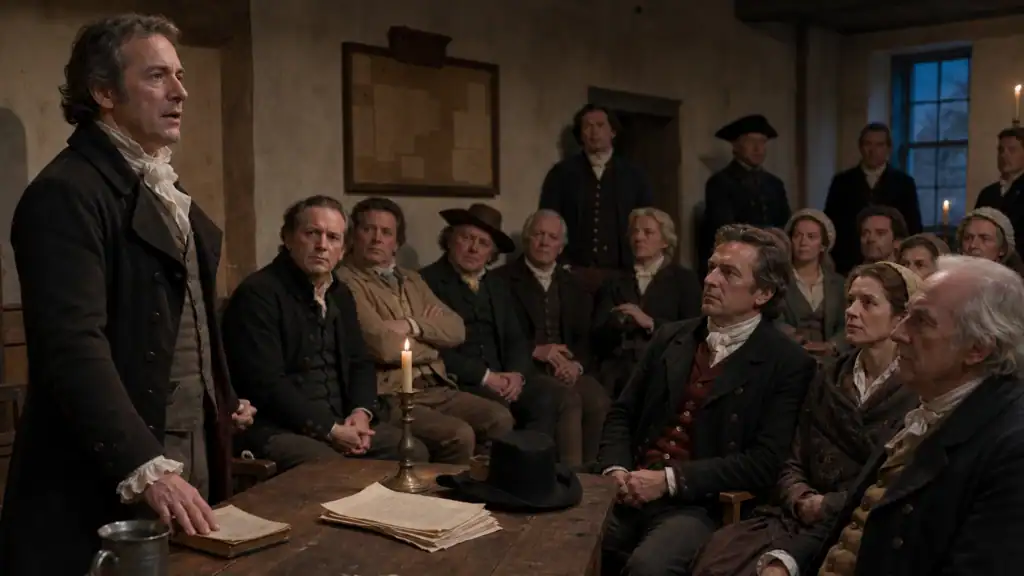
The French Revolution landed in Britain at precisely the moment when British political argument was ready to split along sharper lines. The best known early responses came from Richard Price and Edmund Burke, and their disagreement is more than an intellectual curiosity. It tells us how Britons understood the Revolution through their own constitutional anxieties.
Richard Price welcomed the French events as part of a broader advance of liberty. To him, political reform was not a threat to civilisation but evidence that reason and rights could improve it. He belonged to a tradition that saw history as capable of moral progress. Burke, by contrast, warned that France was tearing down inherited institutions without understanding how fragile social order really was. His critique was not a rejection of change altogether, but a defence of continuity, custom, and prudence. Where Price saw emancipation, Burke saw dangerous abstraction.
The key point is that both men were speaking to Britain as much as to France. Their arguments mattered because they exposed the pressure already inside British politics. Britain liked to present itself as a balanced constitution, one that combined monarchy, aristocracy, and parliament. Yet that constitution rested on profound inequality. Representation was deeply uneven. Some places with shrinking populations still returned members to Parliament, while new industrial towns had little or no voice. Wealth was growing through trade and empire, but that did not automatically widen political participation. The system was resilient, but also exclusionary.
The French Revolution made that contradiction harder to ignore. Reformers could point to Paris and ask why Britain should not modernise its own political arrangements. Conservatives could point to the violence in France and argue that once reform escaped control, it would end in destruction. Liberty and order became the central vocabulary of disagreement, and the Revolution gave both sides a powerful example to deploy.
That is why the period mattered so deeply. The French Revolution was not simply imported as a foreign ideology. It became a mirror held up to British politics, revealing how much of the country’s stability depended on forms of exclusion that had long been tolerated as normal.
The state of British politics before the crisis
Before 1789, Britain was not a democracy in any modern sense, although later memory sometimes smooths it into one. Its constitutional system had real strengths. It had avoided the repeated dynastic catastrophes that had shaken other European states. It possessed parliamentary institutions, legal traditions, and a public political culture more open than many of its continental neighbours. Yet those advantages coexisted with a rigidly unequal distribution of political power.
Property shaped influence. Patronage shaped office. Local elites shaped elections. Industrial growth transformed the economy far faster than the political map. As towns expanded, they often remained underrepresented or not represented at all. Commercial wealth flowed through London, Bristol, Liverpool, and other ports, but the political system did not respond evenly to that transformation. The result was a growing mismatch between economic power and political voice.
That mismatch is one reason the French Revolution mattered so much. It turned Britain into a country watching another society confront questions that Britain itself had postponed. How should power be justified? Who counted as a citizen? What did representation mean when social and economic change was moving ahead of the constitution? These were not abstract questions. They affected trade, taxation, public order, and the credibility of the state.
Britain’s leaders were therefore right to see France as a test, though not in the way they often said publicly. The test was not whether Britain would copy French institutions. It was whether the British constitution could survive without reforming itself. Revolutionary France forced Britons to decide whether loyalty to the existing order was enough, or whether legitimacy required adaptation. The answer was delayed, disputed, and uneven, but the question had already entered the political bloodstream.
Ideas, Print, and the Atlantic World
How revolutionary ideas travelled
Revolutionary ideas do not move on their own. They travel through books, pamphlets, newspapers, letters, sermons, taverns, ports, and ships. That is what made the French Revolution so powerful. It arrived in Britain through the material infrastructure of the Atlantic world. London printers reissued accounts of events in France. Edinburgh and Dublin joined the debate. Merchants carried papers between cities. Sailors spread stories from harbour to harbour. Dissenting congregations and artisan circles discussed rights, representation, and the limits of authority in language that was increasingly direct.
This matters because it changed political language. Before 1789, liberty often belonged to philosophers, lawyers, and theorists. After the French Revolution, it became a practical language for grievances. A weaver could use it to describe wage pressure. A merchant could use it to criticise restrictions. A radical writer could use it to question Parliament. Once the language of rights entered public debate, it was difficult to confine it to elite circles.
The revolution also exposed the power of print itself. The age of the pamphlet was not new, but French events gave print a sharper urgency. People wanted to know what had happened, what it meant, and whether the official versions were trustworthy. That appetite helped create a more politically self aware public. The state could not control interpretation simply by controlling formal institutions. Political meaning now circulated through the same networks that moved goods and credit.
If this sounds like a technical shift, it was not. It changed how ordinary people encountered politics. A dockworker reading a newspaper, a shopkeeper hearing a sermon, or an artisan discussing a pamphlet was participating in the widening of political consciousness. The French Revolution became one of the great accelerants of that process. In Britain, where print culture was already dynamic, the effect was especially strong.
Britain’s wider imperial and Atlantic anxieties
The French Revolution also had to be understood against the background of the American War of Independence. France had helped weaken Britain in North America, but in doing so it had deepened its own financial strain. The result was a transatlantic order under pressure. Britain, France, Spain, and the Dutch all competed in a world where war, debt, commerce, and colonial possession were tightly linked.
British officials worried about more than domestic radicalism. They feared unrest in Ireland, agitation among workers, and criticism of colonial rule. They also understood that revolutionary language might travel across imperial boundaries. If subjects in one part of the empire began to ask why they lacked rights promised elsewhere, the state would face a problem that could not be solved simply by policing London. The same applied to enslaved people, free people of colour, and colonial communities who could hear the contradiction between rhetoric and reality.
This is where the global significance of the Revolution becomes clear. Britain was not defending a neat domestic order. It was defending a world system built on trade routes, plantations, naval power, and unequal labour. Revolutionary France threatened that system both directly and indirectly. Directly, because it was a hostile power. Indirectly, because it made rights talk harder to contain. Officials were therefore reacting not only to ideas but to the possibility that those ideas might connect different grievances across the empire.
That is why the French Revolution mattered more than a simple national crisis. It was a force that connected print, commerce, empire, and politics in a single widening debate about power.
War and the Reorganisation of British Power
Britain enters war with revolutionary France
The conflict between Britain and revolutionary France did not emerge from a single decision, but once war came it transformed the whole political landscape. France declared war on Austria in 1792, and Britain entered the struggle soon afterwards. What had begun as an argument about constitutional principles became a continental and then global contest over authority, resources, and survival.
War hardened attitudes on both sides. Revolutionary France presented itself as defending liberty against old regime hostility. Britain increasingly viewed the French state as a dangerous force capable of exporting instability. The shift was profound. Debate over ideas gave way to struggle over political authority. In the logic of war, compromise became harder to sustain, and suspicion grew more intense.
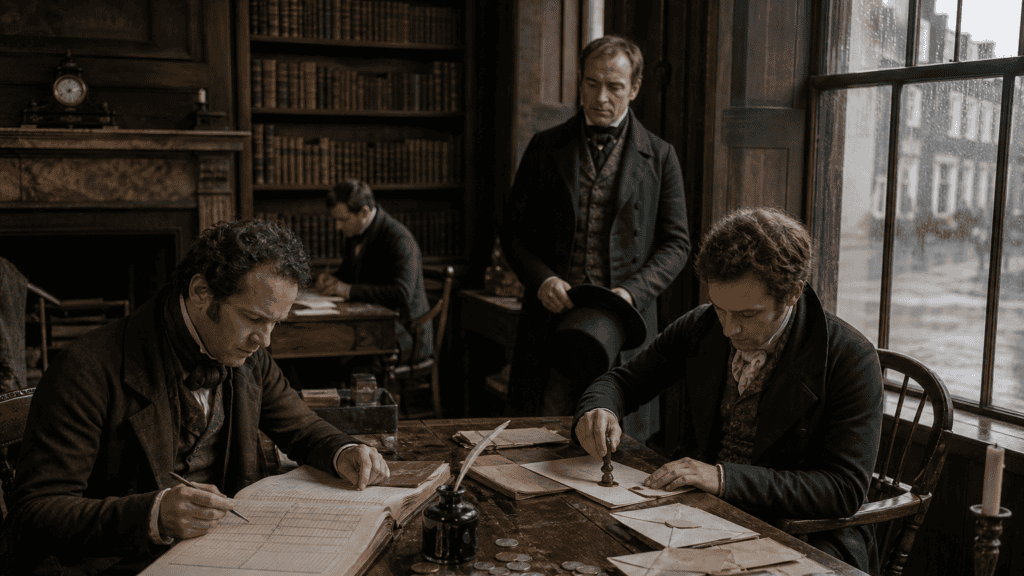
For Britain, this was the start of an extraordinary institutional reorganisation. The country did not just fight France. It changed itself in order to do so. Taxes rose. Borrowing increased. The navy expanded. Supply systems became more sophisticated. Officials worked with merchants, dockyards, insurers, and transport networks to keep the war effort moving. In this sense, war was not only destructive. It was also administrative. It forced Britain to extend the reach of the state into finance, logistics, information, and maritime coordination.
That reorganisation mattered because it helped make Britain a more formidable power after 1815. The state that emerged from the revolutionary and Napoleonic wars was not the same state that had entered them. It was more capable of mobilisation, more dependent on commercial credit, and more deeply tied to imperial circulation. Britain’s strength was not automatic. It was built through the pressures of conflict.
Taxes, the navy, and the growth of the state
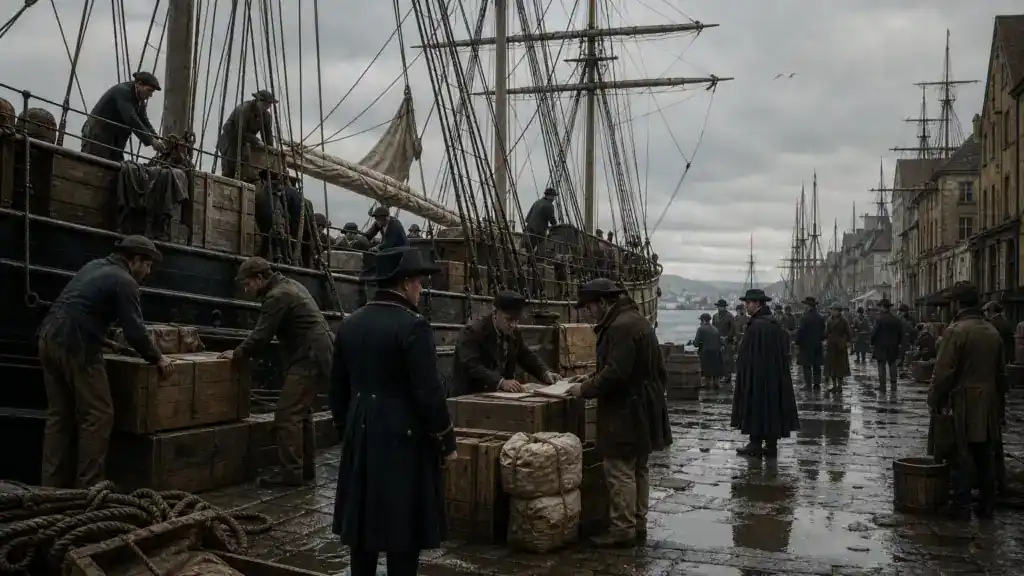
The wartime state had to draw resources from across society. Taxes on consumption and income became more significant. Borrowing allowed the government to sustain vast military commitments, but it also tied the state more closely to financial markets and public credit. The navy became central to survival, not just as a fighting force but as the guardian of trade routes and imperial communications. Ports, dockyards, convoy systems, and shipping schedules became matters of national security.
This was a major turning point in British history. The revolutionary wars helped consolidate a fiscal and naval state capable of acting across the globe. British merchants were not simply private traders. They became part of a national system of war and commerce. Convoys protected goods. Insurance markets spread risk. Dockyards supplied ships. London finance underwrote the whole structure. Britain’s maritime power was not separate from state power. It was one of its chief instruments.
But there was a cost. The growth of capacity also meant the growth of intervention. More money had to be extracted. More information had to be monitored. More routes had to be defended. More lives were subordinated to the demands of war. This is the paradox at the heart of the period. Britain resisted revolutionary instability, but in order to do so it became more centralised, more intrusive, and more dependent on global systems than before.
That is why the French Revolution changed Britain so deeply. It pushed the state to reorganise itself on a scale that would have been difficult to imagine in 1788. The effects lasted far beyond the battlefield.
War, Security, and Civil Liberties
The pressure on ordinary lives
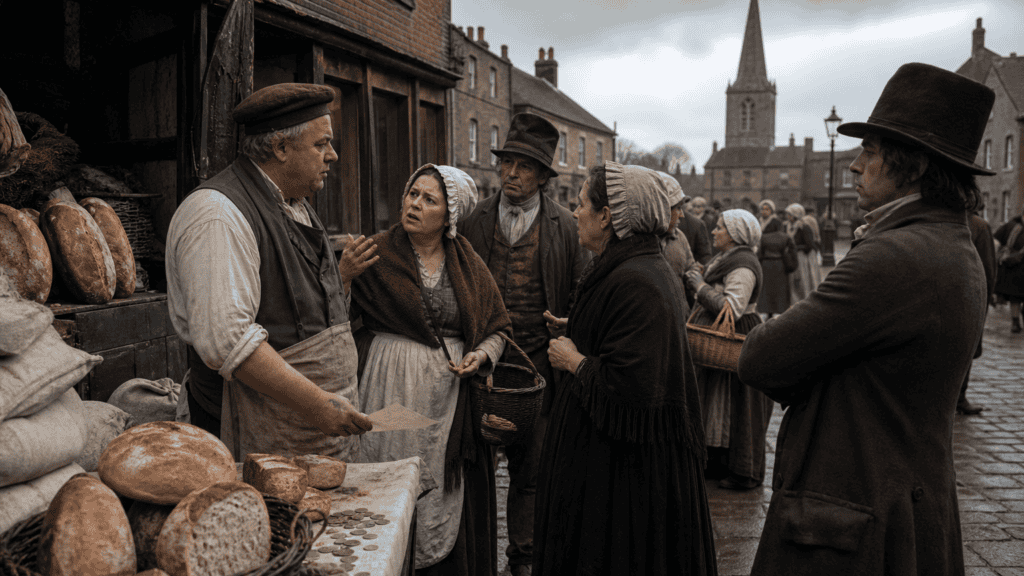
For ordinary people, the French Revolution and the war it unleashed were not experienced as a neat sequence of diplomatic events. They were felt through bread prices, wages, recruitment, and uncertainty. Harvest failures and supply problems made food more expensive. Families already living close to the edge had to cope with military demands and economic instability. In industrial districts and port towns, the pressure could be severe.
This is where global history becomes local. A war over France could be felt in a British kitchen. A disruption in trade could alter the cost of grain. Naval mobilisation could affect employment. Recruitment could remove workers from households and workshops. The Revolution mattered because it linked high politics to daily survival. It brought international conflict into ordinary life.
That connection also helps explain why reform movements gained traction. People did not turn to political organisation only because they read abstract theories. They did so because material hardship sharpened questions about who governed, who benefited, and who paid the costs of state power. Calls for wider representation, shorter parliaments, and political rights found audiences partly because the lived experience of war made those claims feel practical, not theoretical.
Yet we should not reduce everything to crisis. Some Britons feared not change but disorder. For them, the French example showed what happened when political expectations outran institutions. Their response was not irrational. They were looking at a Europe where bread shortages, crowd action, war, and revolution were tightly interwoven. The difficulty is that their fear often led them to defend structures that themselves generated grievance.
Repression and the language of national security
As radical meetings and publications multiplied, the British state responded with surveillance, prosecution, and restriction. Habeas corpus was suspended at moments of particular tension. Authorities watched political societies carefully. Writers and speakers could be accused of sedition. This was not a small matter. It marked a shift in how the state understood dissent.
Before the Revolution, criticism might be treated as troublesome. During the war, it could be treated as dangerous. That transition helped create the modern language of national security. The government increasingly framed restraint not as censorship but as protection. Public freedom was measured against public order, and the balance often tilted towards control.
Again, the significance reaches beyond the immediate years. Britain emerged from the revolutionary era with a stronger state, but also with a deeper habit of surveillance. It had learned that political ideas could move quickly and connect grievances across social boundaries. It had also learned that law could be used to discipline those who questioned the existing order.
The French Revolution mattered, then, because it changed the relationship between state and society. It persuaded rulers that legitimacy could be threatened by more than armies. It could be threatened by pamphlets, meetings, songs, rumours, and the spoken language of dissatisfaction. That lesson would outlast the war itself.
Empire, Slavery, and Revolutionary Possibility
Saint Domingue and the challenge of universal rights
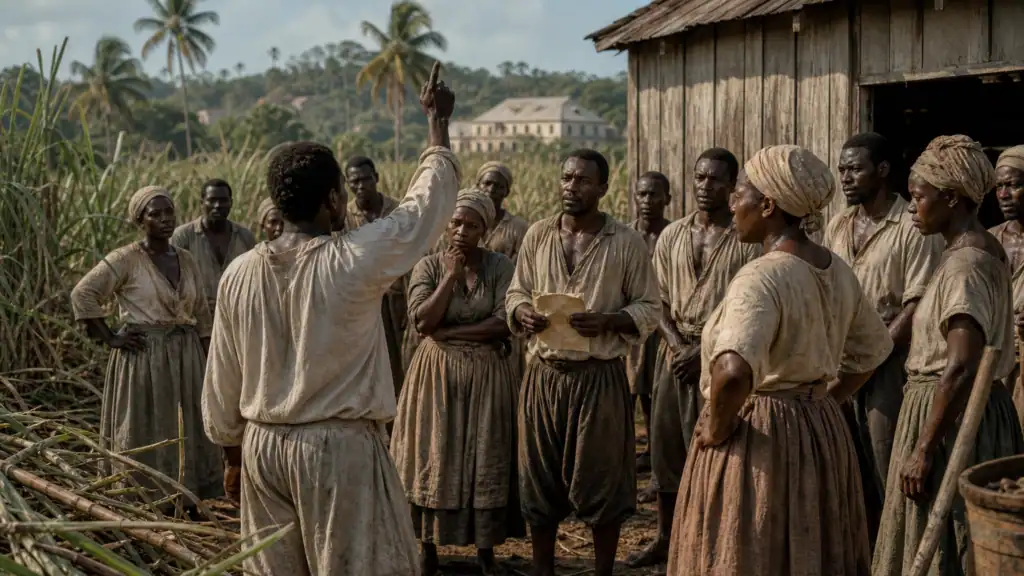
No part of the revolutionary era exposes European contradiction more clearly than Saint Domingue. As the French Revolution proclaimed rights and citizenship, enslaved people in the Caribbean were hearing a different but related message. If men were born free and equal, what did that mean in a colony built upon coercion, exploitation, and racial hierarchy? The answer could not remain theoretical.
In 1791, enslaved people rose in revolt in Saint Domingue. Their struggle evolved into the Haitian Revolution, one of the most important events of the age. It was not an accidental side effect of events in France. It was a direct test of them. Revolutionary language created possibility, even where European powers did not intend it. The claim to universal rights could not be contained once people who had been denied those rights recognised its force.
For Britain, this was alarming and transformative. British politicians could denounce disorder in France while continuing to defend slavery in the Caribbean. That contradiction was increasingly difficult to ignore. Abolitionists seized upon it. They argued that a nation could not claim the moral high ground while tolerating bondage in its own imperial system. The revolutionary era therefore widened the space for anti slavery critique, even if the British state itself remained committed to empire.
This is one of the reasons the French Revolution mattered so much to Britain. It did not just alter political language at home. It destabilised the moral foundations of imperial rule. It forced Britons to confront the fact that liberty and slavery could no longer be kept neatly in separate spheres.
British intervention in the Caribbean
Britain intervened militarily in the Caribbean, hoping to seize French territory and defend its commercial interests. The campaign was costly and often disastrous. Disease took a terrible toll on British troops, as did combat and the sheer difficulty of imposing control in a region where local resistance and environmental conditions favoured defenders and insurgents. The losses were not merely military. They were strategic and financial.
This mattered because it revealed the fragility of European power. Colonial possessions were not passive assets waiting to be claimed. They were contested spaces where enslaved people, local populations, and rival empires all exercised agency. Britain could project force across the Atlantic, but it could not guarantee success. The Caribbean wars exposed the limits of what naval supremacy alone could achieve.
They also connected imperial competition to the wider revolutionary conflict. Britain was fighting France, but it was also fighting over the future of labour, wealth, and sovereignty in the Atlantic world. The stakes were immense. Sugar, shipping, plantation profits, and geopolitical influence all intersected in the same struggle. The French Revolution mattered here because it opened a crisis in imperial legitimacy that neither Britain nor France could fully control.
Napoleon, Commerce, and Global Conflict
The Continental System and British response
By the time Napoleon Bonaparte dominated Europe, the revolutionary phase had changed form, but the consequences of 1789 had expanded rather than diminished. Napoleon was not a simple continuation of the early revolution, yet his rise depended on the state of disruption the Revolution had created. He built power through war, administration, and military prestige, then sought to reshape the continent in Britain’s image of threat and containment.
The resulting struggle was as much commercial as military. Napoleon’s Continental System aimed to exclude British goods from Europe and weaken Britain by strangling trade. Britain answered with blockades and restrictions of its own. Neutral shipping was caught in the middle. Merchants had to navigate shifting rules, interrupted routes, and constant risk. Smuggling flourished because commerce did not simply vanish when states tried to control it. It adapted.
This turned trade itself into a weapon. Ports from the Baltic to the Mediterranean were drawn into the contest. Prices fluctuated. Credit tightened. Consumers felt the effects in the cost and availability of goods. Once again, the war between Britain and France reached far beyond battlefields and diplomacy. It reshaped the material life of Europe.
Britain’s response depended on the very systems the Revolution had accelerated. Naval power protected trade routes. Financial institutions sustained war. Port cities became crucial strategic nodes. The state’s growing capacity and the commercial world’s interdependence made one another stronger. That was the long consequence of the revolutionary era. It did not merely produce conflict. It produced systems capable of surviving conflict by reorganising themselves.
Britain’s expanding global reach
The Napoleonic period also connected Britain to wider opportunities. Disruption in Europe pushed British merchants and officials to think more expansively about India, the Caribbean, North America, and other regions. New markets mattered more when older ones were blocked. Military and commercial pressure on the continent helped accelerate a global outlook in which British power was increasingly judged by access, mobility, and reach.
This was not a clean story of triumph. Wartime disruption hurt communities, raised costs, and created uncertainty. Yet it also enabled Britain to strengthen its position in a larger commercial world. The Royal Navy protected routes and projected force. Finance allowed the state to sustain long conflict. Diplomatic and military crises in Spain and its empire helped open new possibilities in South America, where independence movements began to reshape the political map. British merchants and diplomats watched closely, seeing both political opportunity and commercial possibility.
By 1815, then, Britain had emerged from the revolutionary era transformed. Its navy was more dominant. Its fiscal state was larger. Its imperial and commercial reach was wider. None of that was inevitable. It was all shaped by the shock of 1789 and the wars that followed. The French Revolution mattered because it helped create the conditions under which Britain became a more intensely global power.
Conclusion
The French Revolution did not simply threaten Britain from the outside and then pass away. It altered the very terms on which Britain understood power, authority, commerce, and empire. When the Bastille fell, the immediate significance was symbolic, but symbols matter because they reveal whether a government is still believed. That lesson travelled quickly across the Channel. British merchants, ministers, reformers, and conservatives all read the same news through different fears and hopes, and in doing so they exposed the political fractures already present within Britain itself.
What followed was more than a diplomatic crisis. It was a reshaping of the British state. War against revolutionary France expanded taxation, borrowing, logistics, and naval organisation. It made the state stronger, but also more intrusive. It linked security to trade, ports, finance, and information. At the same time, the Revolution pushed political language outward. It gave reformers new tools, unsettled defenders of privilege, and made questions of representation more difficult to avoid. Britain did not become democratic as a result, but it became harder to pretend that the existing settlement was neutral or complete.
The revolutionary era also exposed imperial contradiction with brutal clarity. The language of liberty could not be kept away from Saint Domingue, where enslaved people transformed the promise of rights into their own revolution. British intervention in the Caribbean showed how costly and fragile empire could be. The same period that strengthened British global power also revealed how much that power depended on coercion, commerce, and control of labour.
That is the deeper reason the French Revolution mattered. It was not just a French political collapse, nor merely the beginning of a long war. It was a turning point in Britain’s relationship with the modern world. It forced Britons to confront the instability beneath their own institutions, and it helped produce the global state and imperial economy that would define the nineteenth century.
If you want to keep exploring these connections, stay with Digging Deep Histories. There is much more to uncover about British attitudes to the French Revolution, Edmund Burke and political conservatism, the Haitian Revolution and the British Empire, the Napoleonic Wars and Britain at sea, and reform and representation in Georgian Britain.