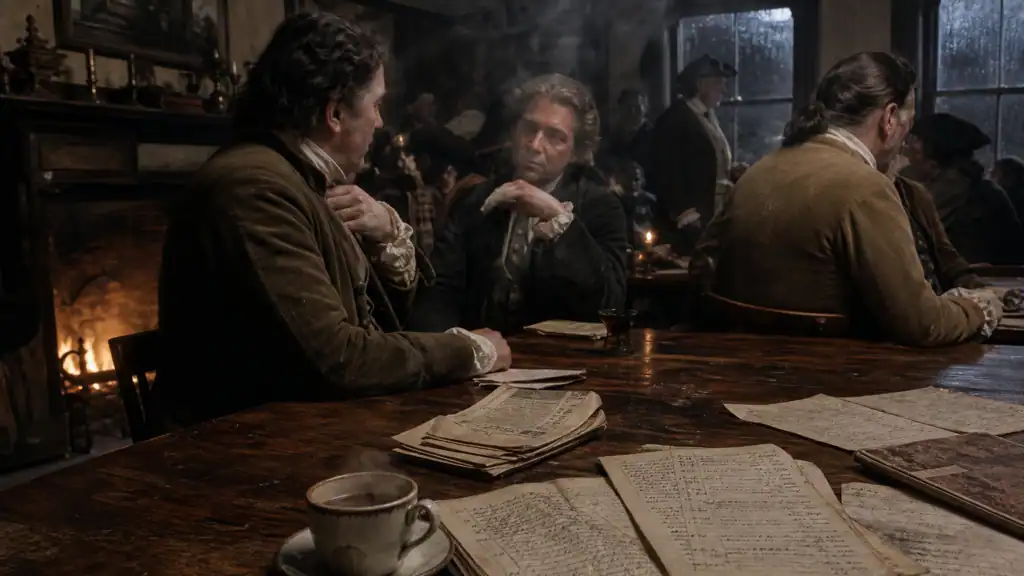

By seven o’clock on a wet London morning, a coffeehouse could already feel busier than some markets did by noon. Rain dragged at the streets outside, but inside there was warmth, steam, damp wool, smoke, and the constant scrape of cups and spoons. A sealed packet might sit on the counter as casually as a napkin, yet the news inside it could alter a merchant’s fortune before breakfast was finished. A shipwreck, a delayed cargo, a false report from abroad, or a rumour from Westminster could ripple through the room with astonishing speed. In Georgian Britain, information did not remain still for long. It crossed tables, interrupted conversations, and shaped decisions while the coffee was still hot.
That is why Georgian coffeehouses matter far more than they are usually given credit for. They were not merely fashionable rooms for drinking an imported beverage. They were places where ordinary people learned how to listen, how to compare accounts, how to judge credibility, and how to turn what they heard into action. They connected Parliament to the Exchange, ports to printers, and private gossip to public consequence. In a society without modern broadcasting, these rooms helped create the habits that made shared news possible. They trained people to live inside a world of circulating information.
Professor Amelia Harcourt wants to take you into those rooms as they really were. Not polished spaces of polite conversation, but crowded environments where bodies, voices, print, memory, class, and gender all shaped what could be known. If you have ever wondered how public opinion first became a force people had to reckon with, Georgian coffeehouses offer one of the clearest answers. They show us how a society begins to treat information not as a private possession, but as something that can move markets, disturb governments, and define reputations. They also remind us that every system of communication has winners and losers, voices that travel and voices that are ignored. That is the hidden history we need to follow.
The Room That Turned News into Action
A crowded social institution, not a quiet café
The modern image of a café can mislead us. We imagine a place for solitude, a pause in the day, perhaps a table near a window and a cup held over a laptop. A Georgian coffeehouse was something altogether different. It was noisy, dense, and alive with competing claims. Newspapers lay open on tables. Pamphlets changed hands. Letters arrived from ports, offices, and country houses. Men leaned together over cups while one voice read aloud and several others interrupted. There was warmth from braziers, smoke from pipes, and the constant friction of people trying to be heard above the room.
This mattered because the coffeehouse was not just a place where news was consumed. It was a place where news was tested. A report from Parliament might be repeated by a clerk, questioned by a merchant, corrected by a man who had just come from another room, and then carried out into the street with its certainty slightly changed. The room taught people that information was not complete when it first arrived. It had to be weighed against other accounts, compared with experience, and judged in public.
That is why these rooms became so central to Georgian urban life, especially in London. They condensed the city’s communication into one shared setting. The coffeehouse acted like a meeting point for different worlds that otherwise would have remained separate. Commercial life, politics, print, and social hierarchy all pressed together at the same tables. In that sense, the coffeehouse was not an escape from the practical world. It was one of the places where the practical world was made legible.
Entry, cost, and participation
The price of admission was often modest, but modest did not mean equal. A penny or a small payment could buy a drink and the right to sit among the company, yet actual participation depended on much more than money. Literacy helped, but memory helped too. Confidence mattered. So did the ability to follow the rules of conversation, to interrupt at the right moment, and to speak with enough force to be heard without appearing vulgar or rude.
For some visitors, the coffeehouse offered one of the few spaces where they could encounter printed news regularly. A man who could not afford many books might still hear newspapers read aloud. A visitor from outside London might absorb the latest commercial or political gossip in a single afternoon. A young apprentice, standing at the edge of the room, could learn what mattered simply by listening. The coffeehouse therefore educated through exposure. It was informal, but it was not chaotic in the sense of being meaningless. It had patterns, expectations, and social rules.
Yet those rules also excluded. A room could be open in principle and still bounded in practice. A person might enter and remain unheard. That difference between presence and influence is central to understanding Georgian public life. A coffeehouse did not create equality. It created an arena in which inequality could be seen, negotiated, and occasionally challenged.

From Luxury Drink to Urban Habit
Coffee’s arrival in Britain
Coffee did not begin as an everyday Georgian drink. It arrived earlier, in the seventeenth century, as an imported curiosity and a fashionable novelty. Like tea and chocolate, it belonged at first to a world of luxury, global exchange, and novelty. Its bitterness, its foreign origins, and the rituals surrounding its preparation made it distinctive. But fashions can become habits when they are attached to daily usefulness, and coffee found exactly that path in Britain.
By the Georgian period, especially in London, coffee had settled into urban routine. It was no longer just an exotic beverage for the socially curious. It became tied to work, reading, business, and conversation. The drink itself encouraged the form the room took. Coffee was quick to serve, easy to share, and suited to long hours of discussion. It kept people alert while they read, listened, and argued. In a city increasingly driven by schedules, commerce, and print, the beverage matched the pace of life around it.
This is where the wider history of Georgian Britain becomes important. The growth of London as a commercial centre meant that more people needed access to timely information. Ships, customs, markets, insurance, and Parliament all generated demand for quick knowledge. Coffeehouses answered that demand because they were well placed within the city’s changing economy. They became part of the ordinary infrastructure of urban life, just as essential to some occupations as counting houses or warehouses.
The rise of specialised coffeehouses
Not all coffeehouses were interchangeable. Over time, many gained reputations associated with particular kinds of customers. Some drew merchants and shipping men. Others attracted writers, lawyers, physicians, booksellers, or political supporters. Lloyd’s Coffee House became linked with marine information and insurance. Garraway’s was associated with commercial and political news. Will’s Coffee House became famous among literary circles. These names matter because they show the coffeehouse as a social map of Georgian Britain.
What made these places powerful was repetition. People returned to the same room, encountered the same faces, and slowly built trust. They did not need to know everything about one another. They only needed to know enough to believe that a report had come from someone with access to useful information. A merchant did not have to trust the whole city, only the network that connected one room to another. In that sense, the coffeehouse was a machine for turning repeated contact into authority.
The system was never perfectly reliable. A report might be true, exaggerated, or planted for effect. Yet that uncertainty was part of the culture. Customers learned to live with incomplete knowledge and to compare one version of events with another. The result was not certainty, but a practical intelligence suited to a changing city.

News, Rumour, and the Coffeehouse Information Chain
How information entered the room
The coffeehouse was powerful because it gathered many sources into one place. A letter from a port could arrive in a merchant’s pocket. A parliamentary report might be copied by a printer and read aloud by a clerk. A traveller from the provinces might bring a story from another county. A servant, a bookseller, or a sailor might carry gossip from one social world into another. Once these fragments entered the room, they became part of a conversation that could spread faster than any single messenger.
This is one of the reasons Georgian coffeehouses mattered so deeply to public life. They connected separate networks into a living chain. Print, speech, memory, and personal reputation all worked together. News was not only consumed by individuals. It was reworked socially. A report heard in one room might be repeated in another, altered slightly in the telling, and then treated as common knowledge before its origin had been checked. That process made the coffeehouse both efficient and unstable.
The speed was remarkable. In a world where transport was slower and official communication often cumbersome, a coffeehouse could move information with striking effectiveness. Yet speed carried risk. The faster a rumour travelled, the less time there was to question it. That combination of quick circulation and uncertain truth is one of the most modern features of the Georgian coffeehouse. It reminds us that systems designed to connect people can also intensify confusion.
The risk of false reports
A false report about a shipwreck, a market crisis, or a political event could have real consequences. Merchants might alter their plans. Insurers might hesitate. Investors might panic. Men who had not seen a source with their own eyes might act as though they had. That is why rumour was never a harmless side effect of coffeehouse culture. It was part of the room’s power and part of its danger.
Customers developed habits of comparison because they had to. They listened for corroboration. They watched who repeated what. They tried to judge whether a story was merely entertaining or genuinely useful. In this sense, the coffeehouse trained people in credibility. It taught them not simply to receive information, but to interrogate it. That is an important historical legacy, because modern public life still depends on this same skill.
If you think of today’s information problems, the parallel is plain enough. People still need to judge reports, identify sources, and distinguish between confidence and accuracy. Georgian coffeehouse culture did not solve that problem. It made the problem visible. It created a daily environment in which truth and error travelled side by side, and where the capacity to tell one from the other became a social advantage.
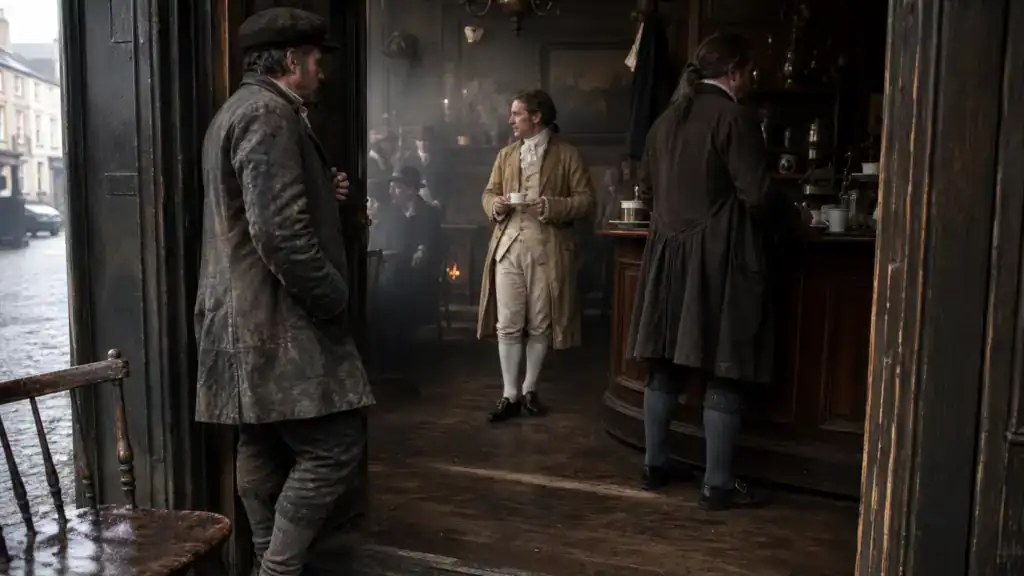
The Coffeehouse as a School of Listening and Judgement
Learning through repeated exposure
One of the most overlooked features of coffeehouse culture is the way it educated by repetition. A single paper could be read by several people, discussed, and remembered collectively. A man who could not afford numerous books could still hear many different reports over the course of a week. Newspapers, pamphlets, and letters became shared materials. They were not consumed in isolation. They were absorbed through social contact.
This changed how people learned. Knowledge was not simply a matter of personal reading. It was also something heard in passing, corrected in conversation, and retained through memory. A young apprentice might listen silently behind older men, gathering information for his master and for himself. A provincial visitor might leave with a better sense of London politics than he had ever gained from correspondence. The room was therefore a kind of practical classroom, though no one would have called it that in the modern sense.
The point is not that everyone emerged equally informed. Far from it. But the coffeehouse made information available in a form that was public, repeatable, and socially charged. It taught people to recognise what mattered by hearing other people discuss it. That habit proved durable. It helped create the expectation that news should be current, discussed, and connected to everyday life.
The rise of judgement as a social act
Coffeehouse conversation did more than transmit facts. It taught judgement as a performance. To say what one thought about a minister, a war, a trade route, or a scandal was to place oneself before others. The room invited comparison. If one man defended a report and another challenged it, the exchange itself became part of the information. A person’s manner of speaking could strengthen or weaken the case. Confidence, wit, and knowledge all mattered.
This is one reason public opinion became such an important idea in Georgian Britain. It was not a single voice, nor was it the will of the whole population. It was a culture of visible judgement, formed in places where people heard each other think aloud. The coffeehouse did not create democracy in a modern sense, but it helped make public disagreement ordinary. That was a profound change.
At the same time, the room rewarded those already equipped to speak. Men of status, learning, and connection were often heard more readily than others. The coffeehouse therefore exposed the social inequalities that shaped speech itself. To listen closely to its culture is to hear not only news, but also the uneven distribution of authority.

Politics, Status, and the Limits of Openness
Private belief becoming public speech
Coffeehouses became politically significant because they connected private belief to public expression. Someone might arrive with a view shaped at home, in a parish, or through family loyalties. Inside the coffeehouse, that view would meet printed arguments, counterclaims, and the force of social disagreement. Political conversation was not separate from the wider world. It was one of the places where the wider world was assembled.
Authorities understood this. During periods of tension, they watched printed material and paid attention to what was being said in public rooms. Governments knew that discussion could become dangerous even without formal organisation. A coffeehouse did not need to issue resolutions to matter politically. It could produce energy simply by bringing people together around contentious information. That is why such rooms worried those in power. They made political feeling audible.
Yet we should not overstate the freedom involved. Coffeehouses were not fully open forums. Owners had their own interests. Customers brought loyalties with them. Social pressure shaped what could be said and what would be dismissed. Still, compared with many other spaces in Georgian society, the coffeehouse allowed a wider range of public speech than many formal institutions did. It was an important part of the history of the British public sphere, even if that phrase should never be used as though it meant universal equality.
The meaning and limits of the penny university
The phrase penny university has often been used to describe the coffeehouse, and it is useful provided we handle it carefully. It captures something real about the educational function of these spaces. A room full of newspapers, pamphlets, arguments, and informed conversation could expose customers to law, science, trade, religion, and foreign affairs. It could widen the mind. It could bring people into contact with ideas they would never encounter at home.
But the phrase can mislead if we imagine a democratic classroom. The coffeehouse educated, but it did not educate everyone equally. Women were often excluded from the main public culture of these rooms. Social status shaped who was listened to. Some people came and went in silence, present but not influential. The room offered access, but access was uneven.
That tension is one of the most revealing things about Georgian coffeehouse culture. It shows how societies can expand discussion without abolishing hierarchy. It shows how openness can coexist with exclusion. And it reminds us that a place can be intellectually lively while still reproducing the assumptions of its age.

Who Was Allowed to Speak
Social rules, masculinity, and respectability
If we want to understand the coffeehouse honestly, we have to ask who belonged there and under what conditions. Respectable dress mattered. Masculine behaviour mattered. So did disposable time, because conversation without hurry was itself a privilege. A person needed to know how to enter the room, how to wait, how to interrupt without offending, and how to speak so as to gain attention rather than ridicule. These were social skills with real value.
That value was tied to class. The merchant, the lawyer, the printer, the apprentice, and the labourer did not occupy the room in the same way. Some were naturally listened to more than others. A person could be physically present and socially unheard. That distinction is crucial. It reminds us that public space is never enough on its own. A room does not create equality simply by existing. Equality depends on the habits, assumptions, and power relations brought into that room.
This is why Georgian coffeehouses should be studied as social institutions rather than romanticised as places of free exchange. They were structured by custom. They rewarded familiarity. They presumed a certain kind of male public behaviour. In doing so, they helped define what respectable discussion looked like in urban Britain.
Women and unequal access
Women were not absent from the wider culture of coffeehouses, but their relationship to it was often indirect. Women could own or manage such establishments. They could supply them. They could hear about them through family, correspondence, or print. Yet the public ideal embodied in the coffeehouse remained overwhelmingly male. That matters because it shaped whose voices became associated with informed judgement.
The exclusion was not total, but it was real. Women’s participation in news culture often took different forms, moving through domestic networks, shopping spaces, correspondence, and reading practices that did not always depend on the coffeehouse room itself. The result was a public culture that was more limited than it liked to imagine. It presented itself as open discussion, while quietly reproducing gendered boundaries.
This is one reason the coffeehouse is such a useful historical subject. It allows us to see how public life was built through partial inclusion. It reveals the gap between ideal and practice. And it helps explain why later debates about access, representation, and voice matter so much. The old room still asks a modern question: who gets to be heard when knowledge is being shared?

Commerce, Trust, and the Legacy of Public Information
Merchants, shipping, and insurance
Few places were more important to commerce than the Georgian coffeehouse. Merchants needed timely information about ships, cargoes, routes, war, shortages, and credit. The coffeehouse gathered those concerns into one environment. It enabled repeated contact with people who knew different parts of the trading world. In that sense, it was not merely adjacent to commerce. It was part of its working infrastructure.
Lloyd’s Coffee House is the clearest example. Its association with marine information and insurance grew from exactly the kind of repeated exchange that coffeehouse life encouraged. Men who needed to assess risk could consult those who had access to reports, witnesses, and shipping intelligence. This was not a perfect system. It depended on trust, and trust could be broken. But it created confidence where confidence was commercially necessary.
That same principle shaped many coffeehouses linked to the wider world of the British Empire and trade networks. Goods moved across oceans, and so did news of those goods. The coffeehouse translated distance into discussion. It made the faraway relevant to the city. That ability to compress distance into shared knowledge is one of its great historical achievements.
Confidence and anxiety in equal measure
The same qualities that made coffeehouses useful also made them risky. Fast information enabled swift decisions, but it also amplified uncertainty. A false report could move faster than a correction. A rumour could create panic. A confident speaker could dominate the room even when poorly informed. The culture of the coffeehouse therefore carried an inbuilt contradiction. It made information valuable precisely because it could change outcomes so quickly.
This contradiction did not vanish when later institutions took over some of the coffeehouse’s functions. It became part of modern public life. Newspapers, reading rooms, clubs, and eventually newer forms of media inherited the same tension between speed and accuracy, attention and truth. Georgian Britain did not escape uncertainty by creating coffeehouses. It learned to live with uncertainty more openly.
That may be their deepest significance. These rooms taught people that a society built on information would never be perfectly stable. It would rely on judgement, trust, comparison, and repeated contact. Once those habits took root, they became hard to unlearn.
Conclusion
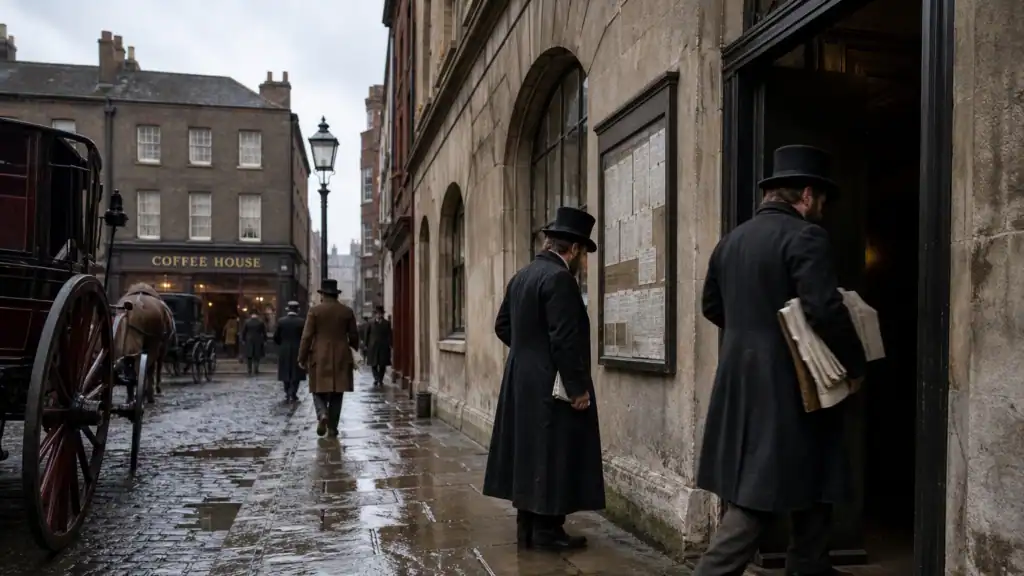
By the early nineteenth century, the coffeehouse was no longer the only place where news was gathered, discussed, and judged. Clubs, newspapers, commercial offices, reading rooms, and other institutions absorbed parts of its role. The centrality of the coffeehouse did not end abruptly, but it did diminish as Georgian society changed. Even so, the habits it fostered survived the buildings themselves. People had learned to expect news at regular intervals. They had learned to discuss distant affairs as though they belonged to local life. They had learned that reputation could be made or damaged in conversation, and that commercial and political decisions depended on what a room thought to be true.
That is why Georgian coffeehouses matter so much in the history of public life. They were not just places where men drank coffee and exchanged gossip. They were environments in which the modern habits of information were rehearsed daily. A newspaper read aloud, a rumour repeated, a pamphlet challenged, a merchant consulted, an apprentice listening at the edge of the room. These were ordinary acts, yet together they created something extraordinary. They helped build a culture in which public opinion could influence markets, shape politics, and give value to being informed.
The larger lesson is not that coffeehouses were democratic in any modern sense. They were not. Women were often excluded, class shaped who was heard, and confidence could outmuscle accuracy. But if we stop there, we miss the deeper historical importance. Georgian coffeehouses exposed a society learning how to think together in public, even while remaining unequal. They made visible the hidden systems of trust, memory, and status that still govern information today. When we ask why rumours spread, why some voices dominate, or why public debate feels both essential and unstable, we are still asking coffeehouse questions.
So the next time you encounter a crowded feed of claims, reactions, and competing versions of events, it is worth remembering those wet London mornings and the packet on the counter. The technology has changed, but the human problem has not. We still gather around shared spaces, whether physical or digital, and decide what to believe together. Georgian coffeehouses did not invent modern media, but they helped create the habits that made it possible. That is a much bigger legacy than most people realise.
If this history has opened up Georgian Britain for you, explore more Digging Deep Histories content on print culture, Parliament, London’s commercial rise, and the wider trading world that shaped everyday life.