

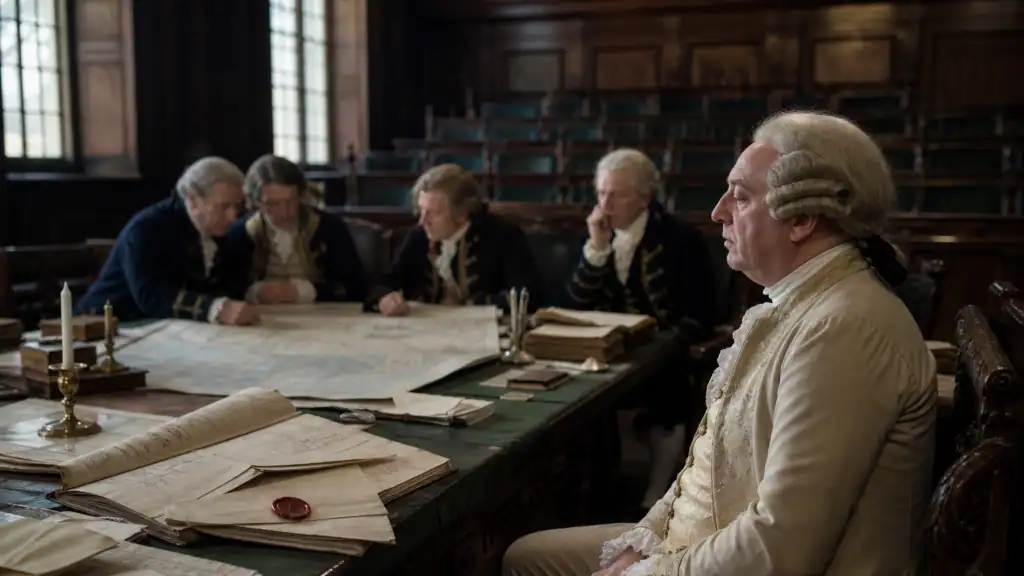
At four o’clock in the morning, St James’s Palace is not a place of spectacle. It is a place of controlled power, where the machinery of monarchy works in low light, behind closed doors, and often with little sign that history is being made. Yet that is precisely the setting in which George III and the American crisis become intelligible. A clerk bends over a document. Candles tremble. A message arrives from across the Atlantic, carrying the political noise of protest, resistance, and defiance into the quiet centre of royal authority. The contrast matters. The British state at this moment appears calm, ordered, and permanent. The colonies, by contrast, seem distant enough to be managed. But the very act of copying a dispatch at dawn suggests a larger truth. What looks remote to power is often already transforming it.
George the Third was not a decorative monarch drifting above events. He was young, serious, and determined to restore dignity to the Crown after a period in which royal influence had been weakened by faction and ministerial dependence. He believed that Britain could not remain strong if law was treated as optional and authority as negotiable. That conviction made him far more than a passive bystander. It placed him at the centre of a constitutional struggle that would reshape both Britain and America. He did not create every policy that led to rupture, but he helped sustain the political logic that made compromise increasingly difficult.
This is why the American crisis matters more than many people realise. It was not simply a colonial quarrel over taxation, nor merely the beginning of the United States. It was a test of what legitimacy meant in an empire built on Parliament, Crown, courts, patronage, and inherited assumptions about obedience. The conflict asked whether a state could govern across the Atlantic without changing the meaning of representation, and whether firmness could preserve authority when subjects no longer accepted its terms. That question would prove explosive. The result was war, independence, and a permanent alteration in the balance between monarchy and Parliament. If you want to understand late eighteenth century Britain, you cannot treat this as a side story. It is one of the defining constitutional crises of the age.
Professor Henry Ashford examines George III and the American Crisis as a struggle over legitimate power, not merely a quarrel over taxes.

A Palace Before Dawn
The message arrives at St James’s Palace
The first thing to notice about the opening of this story is the silence. Great political crises are often imagined as loud affairs, announced by cannon fire, parliamentary speeches, or crowds in the streets. But before a crisis becomes visible, it usually passes through rooms like this one, where servants, clerks, and ministers handle information before the public sees it. At St James’s Palace, the message from America is not yet a declaration of war or independence. It is something more troubling and more revealing: evidence that authority is being questioned far beyond Westminster.
That question matters because the British Empire in the 1760s was not a neat, machine like structure. It depended on information arriving slowly, on local officials enforcing policy, and on the assumption that distant subjects would accept the legitimacy of decisions made in London. When reports came back from the colonies describing refusal, protest, and organised resistance, they were not simply reporting disorder. They were reporting a challenge to the habits of empire itself. Crowds gathered under banners that challenged the Crown. Merchants resisted duties. Colonial leaders spoke as though Parliament’s power had limits. In the language of administrators, this was a problem of obedience. In constitutional terms, it was something more serious.
George the Third received these signs as a young monarch convinced that Britain’s strength depended on disciplined government. He had ascended the throne only a few years earlier, and he saw monarchy as a moral and political office, not a ceremonial one. He was conscientious, earnest, and deeply interested in ruling. If anything, his danger lay not in indifference but in conviction. He believed that firmness was a virtue. He believed that a great power could not permit its laws to be treated as optional. That made him a serious political actor, and it made the crisis harder to resolve.
The great mistake is to imagine that this morning scene is merely a prelude to America’s independence. It is, rather, the first visible sign that an imperial system is encountering a limit it does not yet understand. The palace is quiet, but the old assumptions of rule are already beginning to crack.
George III as a young monarch
George III is often remembered through the later shadows of failure, illness, and defeat. That memory can flatten him into caricature. In the period before the American Revolution reached its full violence, however, he was a young king trying to establish order in a political world still marked by the long aftereffects of the Seven Years’ War. His view of kingship was shaped by duty, discipline, and the belief that the Crown had to stand above faction while still exercising meaningful influence.
He was not an absolute ruler. By the standards of eighteenth century Britain, he operated within a mixed constitution in which Parliament, ministers, courts, and local elites all mattered. Yet within that structure he believed the monarch had a real role to play. He wanted a stronger Crown, not out of vanity alone, but because he feared instability. He saw corruption, weak ministry, and parliamentary manoeuvring as forces that could diminish the state. If government looked hesitant, the empire would look vulnerable.
This is why George’s reaction to American resistance cannot be reduced to personal stubbornness. He understood the conflict as a test of principle. If colonial assemblies could reject parliamentary authority where taxes were concerned, then what would stop them from rejecting it elsewhere? If obedience became selective, imperial governance could unravel. For the king, the issue was not merely revenue. It was legitimacy. The colonies were not being asked to surrender local life, but they were being asked to accept a constitutional settlement that many of them no longer trusted.
That seriousness explains his importance. George III was not a cartoon tyrant and not a helpless figurehead. He was a constitutional monarch with strong beliefs about authority, and those beliefs helped shape one of the most consequential crises of the eighteenth century.
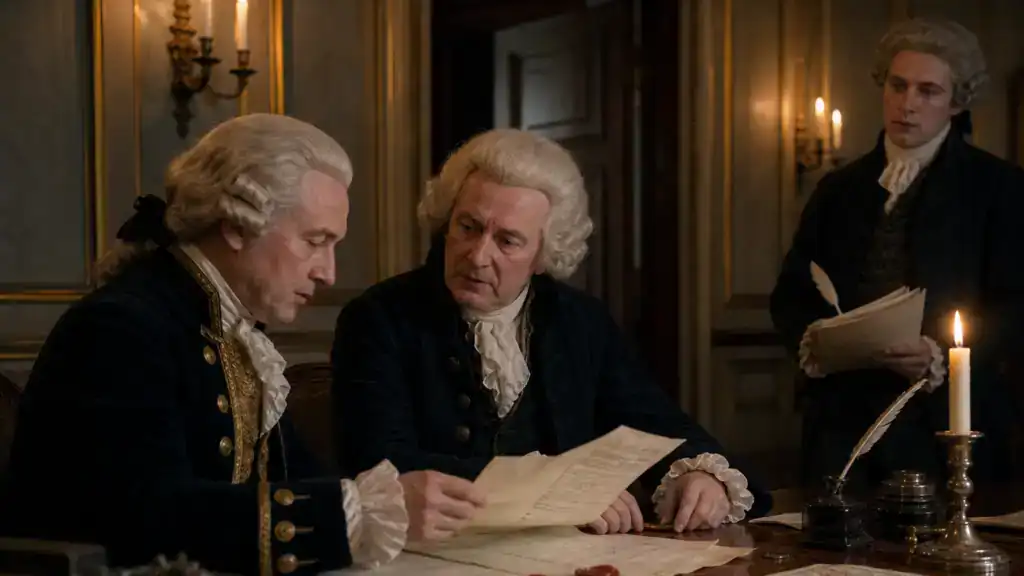
The Question Behind the Taxes
Why Britain changed course after 1763
To understand why the crisis began, you have to begin with war. Britain’s victory in the Seven Years’ War transformed its imperial position, but victory came at a terrible price. The state emerged with a heavy debt burden and a much larger empire to defend. French power in North America had been reduced, but the territory Britain now controlled required troops, administration, and constant attention. Ministers looked at the bill and concluded that the colonies should contribute to their own protection.
This was not simply greed, though critics then and later often presented it that way. It was an imperial response to military expansion. If Britain had fought to secure the colonies, then the colonies, ministers argued, should share the costs. To the men in London, this seemed a practical and fair adjustment to changed circumstances. The state had become more expensive. A wider empire demanded a firmer fiscal structure.
Yet what was practical in Whitehall became alarming in America. Many colonists did not see themselves as conquered provinces or as communities to be taxed by distant rulers without consultation. They had grown used to a degree of autonomy, especially through their own elected assemblies. Those assemblies controlled local taxation, and for many colonists this arrangement was not a convenience but a constitutional expectation. The new imperial measures felt like a breach of custom and right.
This is why the question behind the taxes mattered so much. It was not merely whether revenue should be raised. It was whether the empire was entering a new phase in which Parliament would govern more directly than before. After 1763, Britain no longer behaved like a reluctant overseer of scattered settlements. It began to behave like an integrated imperial state. That shift is central to understanding the crisis. The problem was not only what was taxed, but who had the right to decide.
For readers interested in the wider context, the story begins with the consequences of the Seven Years’ War and Britain’s imperial debt. Once that war ended, the state no longer had the luxury of old arrangements. It wanted colonial contribution, colonial obedience, and a more reliable imperial order. The colonists heard something else entirely.
Colonial resistance before independence
The mistake often made in popular retellings is to imagine that colonial opposition was automatically nationalist. It was not. At the beginning, most resistance was not a demand for secession. It was a defence of rights. Colonists insisted that they were British subjects, and as British subjects they believed they were entitled to the protections of the constitution. Their argument was deeply political and thoroughly British in language.
The phrase taxation without consent was so powerful because it drew on constitutional memory. Taxation, in the colonial mind, was not an ordinary administrative act. It touched property directly. It reached into the household, the shop, and the commercial ledger. If taxation could be imposed without the consent of elected assemblies, then the colonists feared that a fundamental principle of liberty was being eroded. They did not need to believe in democracy as we understand it to feel this danger. They only needed to believe that legitimate government required consent from those being governed.
Westminster did not see the matter that way. British ministers argued that Parliament represented the whole imperial state. They did not mean representation in the narrow colonial sense of local election. They meant that Parliament embodied the nation’s political authority and therefore could legislate for all parts of the empire. This was a constitutional claim, not merely a fiscal one. Each side used the language of law to defend different understandings of political power.
That is why the dispute escalated so quickly. The colonies were not saying government should disappear. They were saying that the terms of government had to respect established rights. Britain replied that the empire could not survive if every locality claimed veto power over imperial decisions. At this stage, both sides believed they were defending the constitution. That fact makes the crisis more revealing, not less. It shows that the conflict was born inside a shared political language that no longer meant the same thing on both sides of the Atlantic.
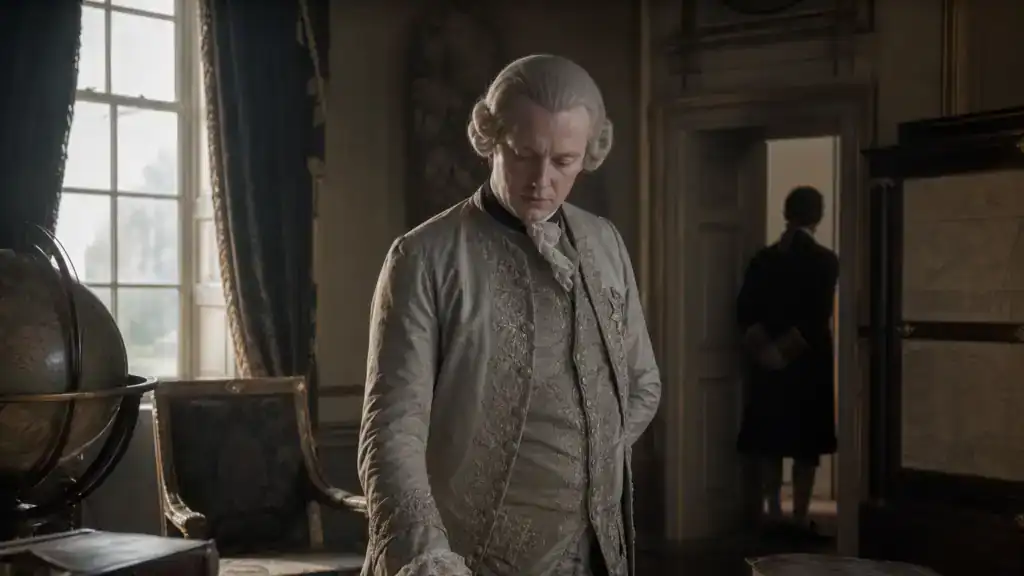
A King, Parliament, and an Empire
Britain as a mixed constitution
Britain in the 1760s was not an absolute monarchy, nor was it a democracy in the modern sense. It was a mixed constitution, and that mix was both its strength and its vulnerability. The Crown retained prestige and influence. Parliament made law and shaped revenue. The courts upheld legal forms. Patronage bound officeholders to political networks. Local power, often exercised by landowners and municipal elites, translated national decisions into practical rule. Governance was dispersed, negotiated, and dependent on custom.
This arrangement made Britain flexible, but it also allowed competing interpretations of authority to coexist until crisis forced them apart. A government built on influence and precedent can function smoothly when agreement is broad. It becomes dangerous when fundamental assumptions divide. That is what happened in the imperial crisis. The structure that allowed so much adaptation also made it hard to settle who had final authority.
George III believed in this constitution, but he interpreted it through the dignity of monarchy. He did not want a return to personal rule in the old absolutist style. What he wanted was a stronger Crown within constitutional limits. He thought ministers had too much freedom and that royal influence should be used more effectively to steady the state. His politics were serious, practical, and conservative in the deepest sense of the word. He wanted to conserve order.
The colonies, however, saw the same constitution differently. Many Americans believed that the British system protected liberty precisely because power was checked by representation and local rights. If London now claimed a broader authority over taxation and administration, then in colonial eyes the balance had changed without consent. The question became not whether Britain had a constitution, but which constitutional principles truly applied across the empire.
This tension helps explain why the American crisis cannot be reduced to simple oppression. Britain did not govern as a uniform autocracy. It governed through layered institutions, and those institutions were open to dispute. That openness was one reason the crisis became so intense. Once rival readings of the constitution emerged, neither side could easily concede without seeming to abandon principle.
Representation across the empire
The argument over representation was at the heart of the crisis. British ministers insisted that Parliament represented the whole empire, even where no colonists had elected members directly. This idea rested on a broader eighteenth century understanding of political authority. Representation was not always imagined as direct and local. It could also mean acting for the whole polity, guided by national interest.
Colonial critics rejected that logic with remarkable force. They argued that taxation was different from general legislation because it took money directly from the subject. If Parliament taxed people who had no voice in the making of that law, then consent had been bypassed. Colonial assemblies, they said, had the right to control local revenue. That right was part of their political inheritance.
This disagreement gave the crisis its constitutional depth. If the empire was merely a set of territories under one sovereign, then Parliament’s claim looked normal. If, however, the colonies possessed a meaningful constitutional identity of their own, then the act of taxation looked like a dangerous innovation. The dispute was therefore about more than money and more than distance. It was about whether imperial governance could remain flexible without becoming incoherent.
George III saw the colonial position as a threat to imperial integrity. If one assembly could refuse Parliament, others might follow. If colonial rights were interpreted as a shield against imperial authority, the whole system could begin to fragment. The king’s fear was not irrational. Empires do depend on enforceable hierarchy. Yet his interpretation also made concession more difficult, because concession could look like surrendering the principle that held the empire together.
This is why the conflict mattered so profoundly. It forced Britain to confront the limits of representation at imperial scale. That problem did not vanish with American independence. It returned, in different forms, in later debates about colonial governance, parliamentary sovereignty, and the relationship between centre and periphery. The crisis was not only a rupture. It was a warning.
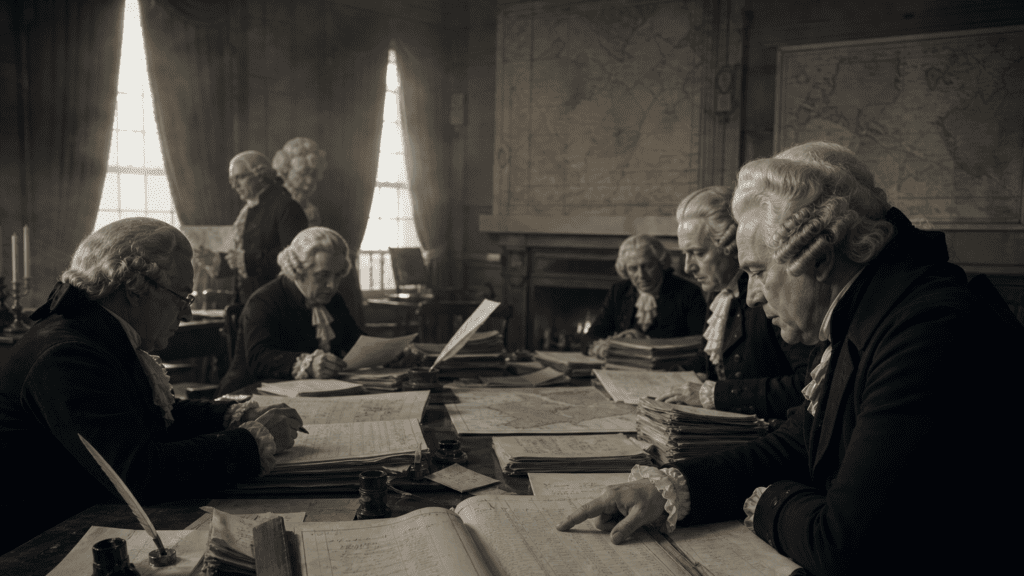
From Protest to Resistance
The Stamp Act crisis
The Stamp Act of 1765 marked a turning point because it touched so many parts of colonial life at once. Printed material was everywhere in the eighteenth century. Newspapers, legal documents, pamphlets, shipping forms, and commercial papers all passed through the world of print. To require a tax stamp on this material was to place the state’s authority directly into the daily business of administration, law, and communication. It was fiscally modest and politically explosive.
The colonial response showed how quickly resistance could become organised. Assemblies protested. Crowds intimidated stamp distributors. Merchants coordinated boycotts of British goods. What began as a fiscal measure became a broader movement of political mobilisation. People who might never have met in ordinary circumstances now found themselves connected through shared grievance and coordinated action. This was one of the great consequences of the crisis. British policy unintentionally helped create the networks that would later support resistance on a much larger scale.
The government eventually repealed the act, but that did not end the matter. Indeed, the repeal revealed the real problem. Parliament could retreat from a measure without retreating from the principle behind it. Colonial leaders understood that immediately. If Britain had conceded on the details but not the doctrine, then the constitutional struggle remained alive. For them, repeal was not full vindication. It was a temporary pause.
The Stamp Act therefore mattered far beyond its short life. It showed that the colonies could coordinate opposition, that imperial authority could be challenged by popular agitation, and that fiscal policy could become a battle over political identity. If you want to understand why the later crisis became so hard to manage, the Stamp Act is the place to begin. It taught both sides that each move would be interpreted as a test of principle.
For readers who want to explore this turning point further, the story of the Stamp Act and colonial protest reveals how quickly constitutional language can become public action. Once protests, boycotts, and crowd pressure entered the picture, the crisis no longer belonged only to ministers.
Repeal, then renewed authority
The repeal of the Stamp Act might have allowed a political settlement if it had been accompanied by genuine uncertainty in London. Instead, Parliament paired repeal with the Declaratory Act. That statute asserted Parliament’s authority to legislate for the colonies in all cases whatsoever. The message was clear enough. Britain had withdrawn one measure, but it had not abandoned the principle of imperial supremacy.
To ministers, this was necessary. They believed the empire could not function if Parliament’s authority were openly questioned. A retreat without declaration would encourage future defiance. To many colonists, however, the Declaratory Act proved that Westminster had not listened to the constitutional argument at all. The real dispute, they concluded, was not over the Stamp Act itself but over whether Parliament could bind them in principle.
This is what made the years after repeal so unstable. The colonists were no longer simply reacting to a single tax. They were watching for signs that Britain intended to govern them as subjects without proper consent. New duties in the 1760s sharpened the conflict. Each policy seemed to confirm the worst suspicions of the other side. London saw resistance and thought of disorder. The colonies saw renewed authority and thought of encroachment.
The violence in Boston in 1770 deepened that divide. The Boston Massacre, as Patriot writers called it, became a powerful piece of political memory. Five colonists died in a confrontation with soldiers, and the event was immediately interpreted through competing lenses. To Patriots, it was proof of military oppression. To government supporters, it was the tragic outcome of crowd hostility and urban disorder. What mattered was not only what happened, but how rapidly the event was placed into a moral narrative.
By the early 1770s, the crisis had become a struggle over interpretation itself. Once a society begins to remember political events in rival versions, compromise becomes harder, because each side is now defending not only policy but memory.
Escalation through the 1760s and early 1770s
The years between the Stamp Act and the tea crisis did not simply contain isolated incidents. They hardened political identities. The empire’s language of reform produced more contention, not less. Duties, enforcement measures, public demonstrations, and pamphlet warfare made the imperial relationship feel increasingly brittle. Government officials interpreted resistance as disorder. Colonial activists interpreted enforcement as tyranny. Neither side could easily hear the other without filtering the message through fear.
This is one reason the American crisis matters so much in the history of political legitimacy. It reveals how quickly constitutional disagreement can become emotional, and how hard it is to reverse that process once rival narratives take hold. Men who began by arguing over legal principle ended by assuming bad faith in the other camp. By the time that happened, the crisis was no longer just about revenue or administration. It was about trust, and trust is far harder to repair than legislation.

Tea, Coercion, and the Fear of Collapse
The Boston Tea Party and British reaction
The destruction of tea in Boston Harbour was not a random act of vandalism. It was a symbolic assault on authority. Tea was both a commodity and a political object, linked to the wider question of whether Parliament could impose its will on the colonies through trade and taxation. When activists destroyed it, they were attacking more than cargo. They were attacking a system.
British ministers, and George III among them, understood this as a dangerous challenge. The response was shaped by a fear that concession would invite still greater defiance. If the government yielded after the tea crisis, what would stop the next outrage? The instinct for firmness was therefore not simply emotional. It was constitutional and strategic. Authority, once visibly weakened, might become impossible to recover.
The punishment that followed was meant to discipline Massachusetts. Instead, it widened the crisis. Coercive measures made other colonies wonder whether they too would be singled out if they resisted. What had been a local confrontation became a continental alarm. Massachusetts was no longer just one colony among many. It became the test case by which others judged the future of imperial liberty.
This episode shows why the crisis cannot be understood as a series of disconnected protests. Each response changed the meaning of the last. The more determined Britain became, the more colonial resistance appeared justified to those already inclined to fear overreach. The more colonial activists struck symbolic blows, the more London believed that the empire was being challenged at its foundations. Both sides were reacting to the same logic of escalation, and both believed themselves to be defending order.
Massachusetts as a test case
The significance of Massachusetts lay not only in its local politics but in its symbolic role. Other colonies watched closely. If Boston could be isolated and forced to submit, then the precedent might be applied elsewhere. If, however, Massachusetts resisted and others offered support, the imperial government would face a larger and more coordinated challenge than it had anticipated.
This is how a colonial dispute becomes an imperial one. Local conflict stops being local once other communities interpret it as a preview of their own future. That is exactly what happened. Colonial solidarity grew not simply from abstract ideology, but from shared fear. Many Americans did not begin by wanting independence. They began by wanting protection from a pattern of coercion they believed might soon reach them too.
George III saw this differently. He believed the empire required clear lines of authority. The Crown and Parliament could not appear uncertain. If they did, the whole political settlement risked unravelling. That belief produced a classic trap. Every measure intended to restore obedience convinced the colonists that the empire was becoming more dangerous. Every colonial act of resistance convinced the government that firmness was necessary. By the time this dynamic settled in, compromise had become harder to imagine because both sides believed retreat would destroy legitimacy.

From Petition to War
The First Continental Congress
By 1774, the colonies were developing new forms of cooperation outside the regular imperial system. The First Continental Congress was a crucial development because it showed that colonial politics had begun to operate at a level beyond individual assemblies. Delegates met, debated, and acted collectively. Yet even then, they were not immediately seeking independence. Their language remained constitutional. They petitioned the king and defended what they saw as inherited rights.
That detail matters. It shows that separation was not the first answer to crisis. Many colonial leaders still hoped that the empire could be corrected rather than destroyed. They wanted recognition, not revolution. But the very existence of a congress beyond ordinary imperial channels signalled that the old structure was no longer sufficient. The colonies were learning to act as a political body.
For George III, this did not look like a plea for compromise. It looked like the beginning of coordinated resistance. He had come to believe that the American movement was no longer aimed at a policy or a ministry, but at the authority of the state itself. Ministers around him reinforced that view. They argued that firmness would reveal the weakness of colonial dissent. In practice, it only deepened mistrust.
The Congress therefore stands as a threshold. It is one thing for people to protest. It is another for them to create a new political forum that claims legitimacy of its own. Once that happens, the imperial settlement is in serious trouble. Authority is no longer being questioned from within the system alone. It is being matched by a rival structure of deliberation.
Lexington and Concord
The fighting at Lexington and Concord in April 1775 transformed a constitutional dispute into armed conflict. Shots were fired, blood was shed, and the political meaning of the crisis changed at once. The important point is not only the military event itself, though that matters. It is that force had entered a disagreement that had still been framed, however uneasily, in legal terms.
Once soldiers and militias were exchanging fire, the possibility of simple settlement diminished sharply. Governments do not easily negotiate with armed rebellion, and rebels do not easily return to obedience after blood has been spilled. The symbolism of the event was immense. It marked the moment when argument was no longer enough to contain the crisis.
George III did not command troops in the field, and it would be wrong to pretend that he alone designed every policy that produced war. Yet his support for coercive government was important. He believed that concession risked rewarding rebellion and encouraging further disorder. His judgement was shaped by a deep fear that authority, once weakened, would not recover. In that sense, he acted as a king committed to the integrity of the state. He also helped close off avenues that might have preserved the union.
The tragedy of Lexington and Concord is that each side could now point to the other as proof of its own fears. The government could say rebellion had broken out. The colonists could say the state had used force against constitutional complaint. At that moment, the crisis became self reinforcing. Violence confirmed suspicion, and suspicion justified further violence.
George III and the logic of firmness
George’s logic was straightforward, if dangerous. He believed that a great state survives by making obedience credible. If colonies or subjects learn that pressure can alter policy, then authority becomes conditional. From his perspective, firmness was not cruelty. It was duty. That helps explain why he supported the coercive direction of government even when the consequences were worsening.
Yet the trap was obvious once the fighting began. Concessions might have seemed to reward rebellion. Refusal of concessions made rebellion more likely. Each side thought the other was endangering legitimacy. The Crown saw a challenge to sovereignty. The colonists saw power without consent. That is why the conflict became so difficult to stop. Constitutional language had become a weapon, and once that happens, it is often the battlefield that decides the matter.

Independence and the Wider War
The Declaration of Independence
The Declaration of Independence in 1776 changed the meaning of the conflict. Until then, many colonists had claimed the rights of Englishmen. After the declaration, they spoke the language of separate states and the consent of the governed. That was a decisive break. It was not merely an escalation. It was a redefinition of political legitimacy.
This shift mattered because it moved the argument from reform within the empire to a claim about sovereignty itself. If governments derive just powers from the consent of the governed, then authority without consent is not merely flawed. It is illegitimate. That idea gave the American cause a powerful philosophical foundation, one that would resonate far beyond the war.
For George III, the declaration was rebellion made explicit. It confirmed what he and his ministers feared, that compromise had given way to separation. The British state now had to fight not only to reassert authority but to decide whether imperial authority could survive such a challenge at all. The war widened immediately, for once France and Spain entered the struggle the conflict became part of a global imperial contest.
This step should not be underestimated. Independence was not a foregone conclusion from the beginning. It emerged through escalation, failed compromise, and mutual hardening. That is what gives the crisis its historical importance. A relationship that had once been politically flexible became impossible to sustain on old terms.
Britain, France, and the costs of empire
Once the war widened, British strategy faced severe practical problems. Distance across the Atlantic created enormous logistical strain. Troops needed transport, food, ammunition, and reliable intelligence. Campaigns depended on weather, shipping, and the long delay between decisions and outcomes. Britain could win battles and still fail to control the war’s larger dynamics.
France and Spain turned what had begun as an imperial dispute into a wider international struggle. This was a reminder that eighteenth century empire was never purely local. Colonial crises were always vulnerable to foreign intervention. Britain’s military successes could not erase the challenge of distance or the cost of holding a continent.
The final British defeat was therefore not simply a military story. It was a constitutional and administrative story as well. A state can win engagements and still lose an empire if the political cost becomes too high. That was exactly what happened. The war showed the limits of coercion across the Atlantic and the difficulty of turning imperial principle into effective control.
If this wider imperial frame interests you, the road to American independence becomes clearer when placed beside Lord North and the political burden of the war years. The ministry had to sustain a conflict that was expensive, divisive, and increasingly hard to justify.
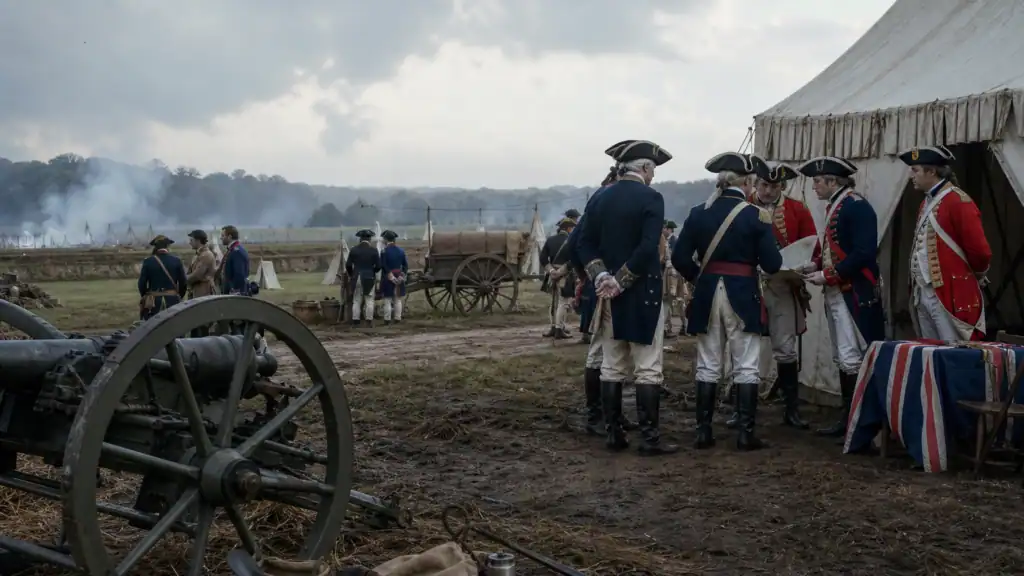
Defeat, Settlement, and Political Consequences
Yorktown and the collapse of the war effort
The surrender of Lord Cornwallis at Yorktown in 1781 did not end the war immediately, but it changed everything. Militarily, it was a devastating blow. Politically, it shattered confidence in the possibility of restoring control over the colonies. Britain could no longer assume that victory was simply a matter of time and persistence.
Morale in London suffered. So did the credibility of those who had defended continued war. The conflict had already become expensive. It was now also unpopular and increasingly difficult to defend in Parliament. Yorktown altered the balance because it showed that the American cause would not collapse under pressure. Britain would have to choose between prolonging a costly war and negotiating an outcome that acknowledged reality.
That choice led to the ministry’s fall in 1782. Governments in Britain could and did change, which is one of the system’s enduring strengths. The fall of ministers demonstrated that defeat in America did not mean the collapse of the British state. It meant political adjustment. This is another reason the crisis mattered more than people often realise. It tested the resilience of the constitution as much as the fate of the empire.
Treaty of Paris and aftermath
The Treaty of Paris in 1783 formally recognised American independence. That was the legal end point of the crisis, but not its only consequence. Britain did not collapse. Monarchy did not disappear. Parliament did not cease to function. Instead, the state adapted, and that adaptation is itself historically significant.
The British political system had failed to keep the American colonies, but it had not failed to survive the loss. Indeed, one of the lessons of the crisis was that the constitution could absorb defeat and continue. That adaptability would matter in later imperial and domestic debates. Britain emerged chastened, but not broken.
For those interested in the wider diplomatic ending, the Treaty of Paris 1783 and the end of the war show how political settlement can follow military disappointment without destroying a state. The outcome was not triumph. It was reordering. And reordering, in constitutional history, can matter as much as victory.
What George III Lost, and What He Kept
Reputation and responsibility
George III’s reputation suffered badly from the American defeat. Later generations would often blame him personally for the loss of the colonies, as though kings alone make empire and lose wars. That is too simple. He certainly supported a policy that failed. He backed firmness, resisted concessions, and interpreted colonial resistance as a threat to authority. But he did so within a wider political system in which ministers, Parliament, imperial assumptions, and military realities all shaped outcomes.
That wider perspective matters. George was not an isolated autocrat. He was part of a state that had chosen to press its authority more directly after 1763. When that decision proved disastrous, the consequences attached to the Crown as well as to the ministry. The king bore the reputation of failure because monarchy still carried symbolic weight. Yet the system itself remained intact enough