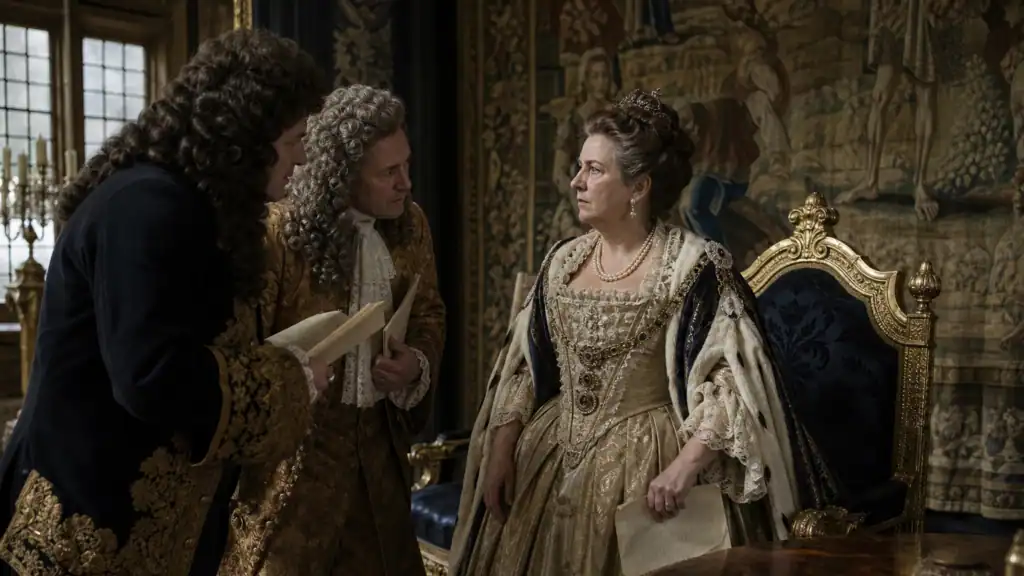

On 8 March 1702, in the solemn hush of St Paul’s Chapel at Westminster, Queen Anne stood at the burial of her brother King William III while the future of the British Isles remained unsettled and fragile. The candles burned low, wax pooled around their bases, and the ceremony offered the outward appearance of order. Yet the political reality behind the rites was far less secure. Anne was thirty-seven years old, widowed in effect by dynastic misfortune, and without a surviving child to follow her. That fact mattered more than the ceremonial dignity of the moment. It meant that every observer, from ministers to foreign diplomats, was already looking past the funeral towards the next succession crisis.
This was not a kingdom waiting quietly for its monarch to be crowned in peace. It was a realm formed by the memory of revolution, divided by confessional loyalties, strained by war, and haunted by the possibility that the wrong heir might undo everything. Across the Channel, a rival claimant waited under French protection. In Westminster, politicians were calculating how to preserve a Protestant settlement that had only recently been secured after the removal of James II. In Edinburgh, Scottish leaders watched English politics with suspicion and with calculation, aware that their own Parliament had not shaped the settlement now governing the crown. The Union of 1707 did not emerge from a wave of patriotic enthusiasm. It grew from anxiety, bargaining, and hard political necessity.
That is why Queen Anne and the Act of Union matter more than many people realise. The union was not simply an administrative merger, nor a neat constitutional milestone placed tidily in the national story. It was a response to danger. It was a settlement shaped by succession, security, finance, trade, and the competing claims of two kingdoms that shared a monarch but not a political system. To understand why Great Britain came into being, one must first understand why England and Scotland had become, in the eyes of their rulers, too dangerous to leave as they were.
I am Professor Henry Ashford, and in this examination of Queen Anne and the Act of Union, I want to show you how a constitutional agreement became one of the most consequential acts of statecraft in early eighteenth-century Britain. The real story is not of a union calmly planned in advance. It is of a monarchy under pressure, a Parliament seeking stability, and a nation still trying to decide what kind of political order it wished to inhabit.
The Funeral That Framed a Future
Anne in St Paul’s Chapel
The funeral of King William III was never merely a private act of mourning. In 1702, royal ritual was political theatre, and every participant understood that the dead king’s burial marked the end of one political arrangement and the beginning of another. Queen Anne, dressed in cloth of gold and framed by the authority of the chapel, presented a picture of continuity. The crown remained. The monarchy endured. But continuity was only the surface. Underneath, the inheritance of the throne was uncertain enough to trouble ministers, diplomats, and Parliament alike.
Anne’s age mattered because she was still young enough to govern for years, but old enough for observers to know that time was passing without an heir. Her children had died. The Stuart succession, once an apparently natural line of descent, had become narrow and unstable. In an age when monarchy was inseparable from dynasty, this was not a minor personal sorrow. It was a constitutional problem. If Anne died childless, then the crown would pass according to arrangements made elsewhere, and those arrangements did not satisfy everyone within the British Isles.
The chapel setting sharpened the contrast between ceremony and uncertainty. Candles, incense, and the hush of mourning implied a settled sacred order. Yet politics in 1702 offered no such repose. The state was not ending a reign and beginning a simple new one. It was carrying a series of unresolved questions into the reign of a queen who had to manage them while being watched from every side. That is why the burial of William III is such a revealing starting point. It shows a monarchy that appeared stable in public while carrying deep instability in private.
A Throne Under Pressure
Anne inherited more than a crown. She inherited a crisis of legitimacy that had developed over the previous decade. The most immediate problem was the rival claimant in exile, a Catholic heir sustained by French protection and by the loyalties of those who never accepted the Revolution settlement. Ministers in London knew very well that succession was not an abstract matter. A contested crown could become a contested kingdom, and in the early eighteenth century contested kingdoms invited foreign intervention.
The threat was political as much as dynastic. The settlement after 1688 had been designed to end the turmoil associated with James II by placing the monarchy on Protestant foundations. Yet if Anne failed to produce an heir, the question of who should follow her reopened the deepest anxieties of the age. Parliament looked to the Act of Settlement of 1701 as a legal answer to a political danger, but a legal answer does not automatically produce popular consent. In Scotland especially, where the settlement had been made without a full sense of shared national agreement, doubts remained about whether Westminster had the right to determine the future of the crown for both kingdoms.
Europe magnified the pressure. England was already thinking in terms of war, alliance, and balance of power. If the succession faltered, then the British Isles could become a prize in a wider European contest. That is the setting in which the Union must be understood. It was not an elegant constitutional experiment conceived in tranquillity. It was a measure taken because the future of the kingdom looked dangerous enough to demand it.
A Kingdom With Two Futures
The Legacy of 1688
To understand Anne’s reign, one must begin with the Revolution of 1688 and the political settlement it created. James II had been removed because many of his subjects feared a return to Catholic monarchy, arbitrary rule, and the erosion of Protestant liberties. William and Mary were brought in as a safeguard, not simply as new sovereigns, and their title rested on a condition that monarchy would now be constrained by Parliament and by law. Anne inherited that altered political world. She was a Protestant queen in a kingdom that had made Protestant succession the basis of legitimacy.
Yet the settlement remained fragile because the memory of displacement had not faded. Those who accepted the Revolution could still worry about what happened next. The Crown was no longer secure merely because it existed. It had to be anchored in law and in an accepted line of succession. The Act of Settlement of 1701 was meant to do precisely that by directing the crown to the Protestant House of Hanover if Anne died without heirs. Westminster saw this as a safeguard against Catholic restoration. But Scotland had its own political traditions and its own Parliament, and legal certainty in one kingdom did not create emotional certainty in the other.
This is why the Revolution’s legacy matters so much to the story of the Union. The Act of Settlement was not just a technical constitutional measure. It was an assertion that legitimacy would now be shaped by Parliament, Protestantism, and state security. Yet because Britain was still a composite monarchy, not a single fully unified kingdom, that assertion could not simply be imposed without consequence. The union emerged as one answer to a problem produced by the Revolution settlement itself.
The Problem of No Heir
Anne’s personal tragedy was also a political disaster. She had experienced repeated pregnancies and the deaths of her children, leaving behind no surviving heir to secure the dynasty in the usual way. In a modern constitutional system, succession can be managed through impersonal rules alone. In early eighteenth century Britain, dynastic fertility still carried enormous political weight. The monarch’s body and the state’s future were closely connected. A childless queen made that connection painfully visible.
Westminster therefore turned to Hanover because it needed certainty. The Protestant succession had to be protected from the chance of a Catholic restoration and from the possibility that the kingdom might fragment into rival allegiances. But legal succession did not guarantee acceptance everywhere. In Scotland, there were politicians who resented the Act of Settlement because they had not shaped it and because it seemed to subordinate Scottish choice to English parliamentary will. Others saw in the uncertainty an opportunity to bargain for a better constitutional position, or even for a different future altogether.
The result was a dangerous gap between law and politics. On paper, the succession appeared to be resolved. In practice, it remained vulnerable to resistance, delay, and opportunism. That gap is one of the reasons the Union became so important. It was designed to reduce the number of ways in which the succession crisis could turn into a national crisis. The absence of an heir did not merely complicate Anne’s reign. It made the structure of the two kingdoms itself look unstable.
Why Disunion Became Dangerous
Shared Monarch, Separate Kingdoms
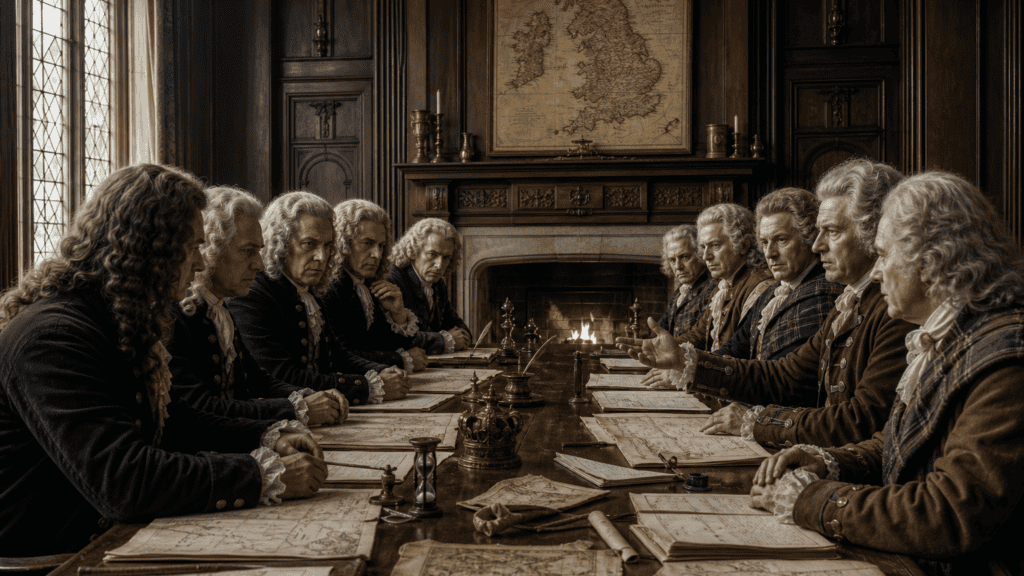
England and Scotland had shared a monarch since 1603, but they remained separate kingdoms in almost every other respect. They had their own Parliaments, their own legal traditions, their own churches, and distinct commercial systems. This arrangement could function when the wider political climate was calm. It became much harder to manage when Europe was at war and when succession was uncertain. The problem was not simply that there were two kingdoms. It was that they could act in different directions while relying on the same crown.
That division was a strategic vulnerability. If Scotland and England followed different lines of succession, then the same island could contain rival states. A European power seeking advantage would hardly ignore such an opening. England feared that a separate Scotland might become a route for French influence or for Jacobite restoration. Scotland feared the opposite danger, namely that English power would swallow Scottish independence under the language of common security. Each side read the other through suspicion.
The composite nature of the monarchy made matters worse. A single sovereign did not mean a single state. It meant overlapping institutions, different political expectations, and diverging interests under one royal head. That kind of arrangement can survive for a long time, but it is exposed when war, debt, and succession bring pressure to bear. The Union did not begin because both kingdoms were eager to become one. It began because the old arrangement had become too risky for both.
Fear on Both Sides of the Border
The mutual fear was real, and it deserves to be taken seriously rather than reduced to later stereotypes about English calculation and Scottish grievance. English ministers were not imagining danger when they worried about a vulnerable northern frontier. The memories of civil war, Jacobite loyalty, and French interference were too recent for comfort. A separate Scottish Parliament could, in the wrong circumstances, choose a path that endangered the Protestant succession and invited external support for a rival claimant.
Scottish anxiety was equally grounded. Many Scots believed that England had little interest in Scottish welfare beyond its own security. The failure of the Darien scheme had left painful scars, both financial and emotional. That project had promised overseas ambition and colonial opportunity, yet it collapsed amid disease, poor planning, and a hostile international environment. Many Scots concluded that English restrictions and English indifference had contributed to their humiliation. Such memories made union feel less like a partnership and more like submission.
This is where the story becomes more subtle than patriotic rhetoric allows. Disunion was dangerous not because one side was wholly righteous and the other wholly selfish, but because both believed they were defending themselves against exploitation. That is why the negotiations were so hard. The issue was never simply whether to unite. It was what terms could possibly make union acceptable to two kingdoms that trusted each other so little.

Queen Anne’s Political Role
A Monarch With Influence, Not Absolute Power
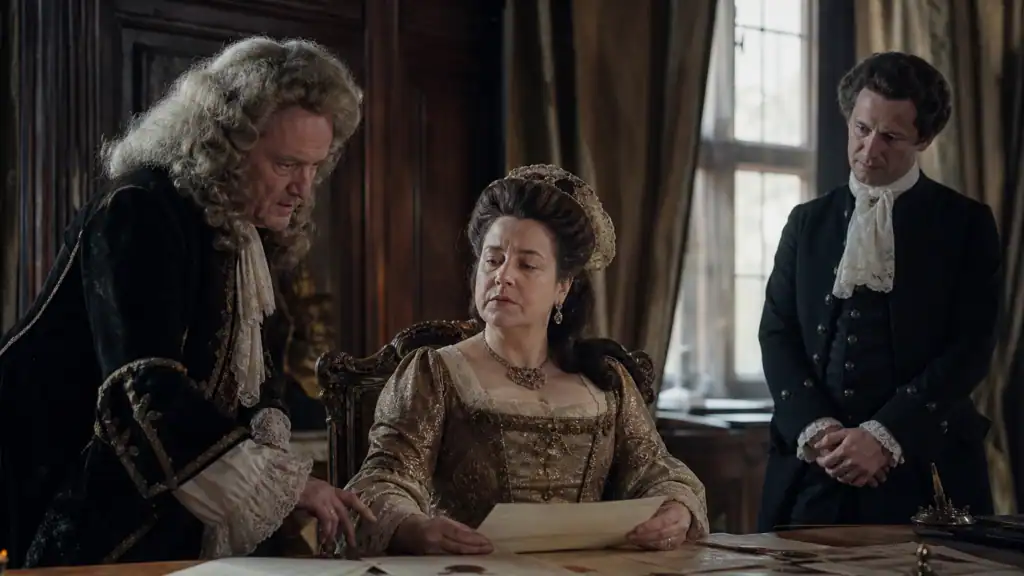
Anne was not a powerless figure watching events unfold around her. The post 1688 monarchy was limited in ways that earlier Stuart kings had not been, but it still carried considerable influence. Anne appointed ministers, received advice, managed access to her presence, and used the authority of the crown to shape political balance. Those who imagine constitutional monarchy as ceremonial and passive are missing the reality of her reign. She was a working monarch, engaged in the machinery of government even as that machinery increasingly depended on Parliament and ministers.
Her influence was especially important because the union required not only parliamentary approval but also royal support. Anne’s role was not to invent the settlement on her own, but to sustain the political environment in which it could be achieved. That meant listening, balancing interests, and using the court as a site of political negotiation. In a world where access to the sovereign still mattered, the crown remained a centre of power even when it no longer ruled by command alone.
What Anne’s reign reveals is that constitutional change is rarely a clean transfer from one kind of authority to another. It is usually a process of adjustment in which the monarchy remains central while its powers are reinterpreted. Anne’s authority was real, but it had to operate through institutions whose importance had been growing since the Revolution. She stood at the point where older royal government and newer parliamentary governance were being forced into a working relationship.
Church, Loyalty, and Court Politics
Anne’s personal convictions were not incidental to the story. She was a committed Anglican, loyal to the established Church of England and deeply attentive to the religious foundations of her monarchy. In early eighteenth-century Britain, religion and politics were still inseparable. The Protestant succession was not merely a constitutional convenience. It was a confessional settlement designed to secure the regime after the upheavals of the previous generation.
At court, Anne also had to manage Scottish figures whose interests could not be ignored. Any union settlement that simply treated Scotland as a subordinate appendage would be politically fragile. She needed to listen carefully, to understand where compromise was possible, and to recognise that court politics could shape national politics. Her reign was therefore marked by a change in the language of power. Royal command mattered, but so did persuasion, patronage, and the ability to keep competing factions within reach of agreement.
This was not a world of modern party politics in the fully developed sense. It was a political culture in transition, where monarchy still mattered intensely but where the crown could no longer behave as though Parliament were secondary. The union belongs in that wider transformation. It shows a queen governing not by absolutist instinct but by negotiation within a changing constitutional order. That is one reason the event mattered so profoundly. It was one of the moments when Britain learned to govern through institutional compromise rather than dynastic certainty alone.
Negotiating the Union
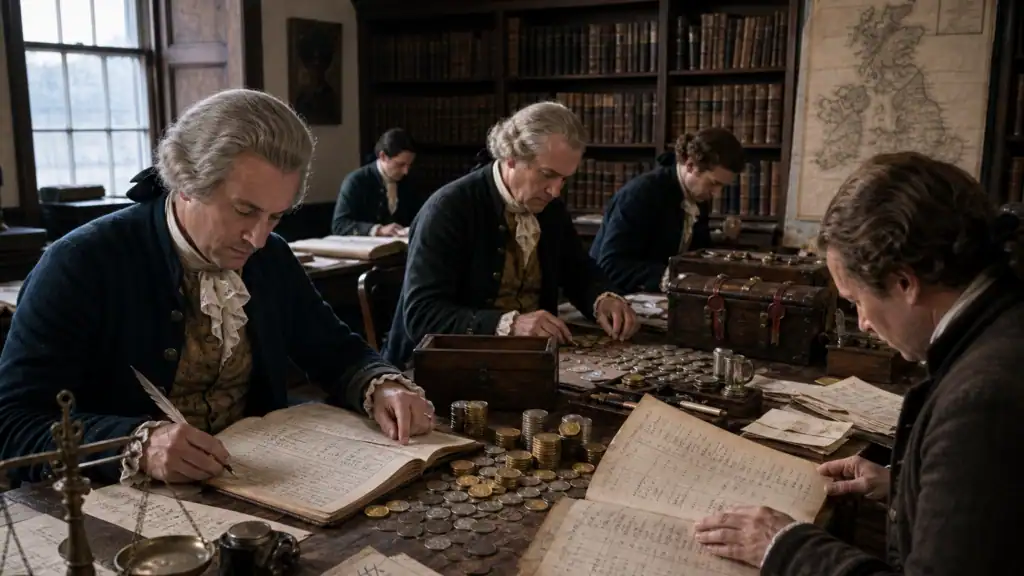
Commissioners and Compromise
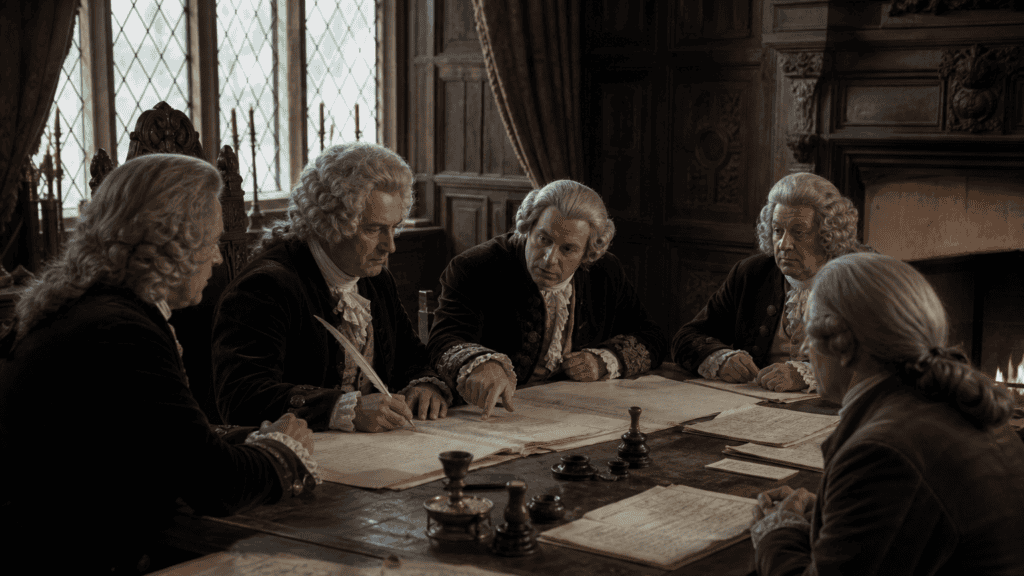
The Union was not drafted in a single burst of inspiration. It was negotiated through commissioners appointed by both kingdoms, and those commissioners faced a task that bordered on the impossible. England wanted a settlement that would secure the Protestant succession, simplify defence, and bring commercial stability. Scotland wanted guarantees that its laws, church, and national identity would not be absorbed into a larger English system. Neither side could gain everything it sought, and both understood that failure carried risks.
This was hard bargaining, not idealistic fusion. The English commissioners brought pressure, calculation, and a clear sense that the existing settlement could not continue indefinitely. The Scottish commissioners had to defend their kingdom’s interests in a context where economic weakness limited their leverage. Yet the negotiations did not simply produce English victory dressed up as compromise. They produced a new constitutional structure with real protections for Scotland.
That is why the outcome cannot be described honestly as the abolition of Scotland. The union did not erase the kingdom. It transferred certain powers into a shared political framework while leaving significant institutions intact. Scottish private law remained. The Presbyterian Church of Scotland was preserved. Representation at Westminster was limited but real. These were not decorative concessions. They were the terms on which the new state could function.
The Shape of the New Settlement
The most visible result of the negotiations was the creation of one Parliament of Great Britain at Westminster. Scotland would send forty-five members to the House of Commons and sixteen representative peers to the House of Lords. Customs barriers were removed, trade arrangements were unified, and the succession became one for both kingdoms. The royal style changed because the state itself had changed. Anne became the first monarch of Great Britain.
Yet the settlement was deliberately uneven. The union joined the kingdoms without levelling them. Scottish law survived, as did the Presbyterian Church. This mattered because constitutional survival often depends on accepting difference rather than erasing it. A genuinely centralised Britain did not yet exist. What emerged was a shared state built around common succession, common security, and common commercial rules, while still leaving room for older institutions to endure.
That design tells us something important about early eighteenth-century statecraft. The goal was not perfect uniformity. The goal was durability. The new settlement had to be strong enough to prevent rival successions and foreign exploitation, but flexible enough to absorb Scottish distinctiveness. That balancing act was one of the reasons the Union endured, even as it remained controversial. It was not a final resolution to every conflict. It was a framework for containing conflict within a larger political order.
Money, Pressure, and Public Anger
Opposition in Scotland
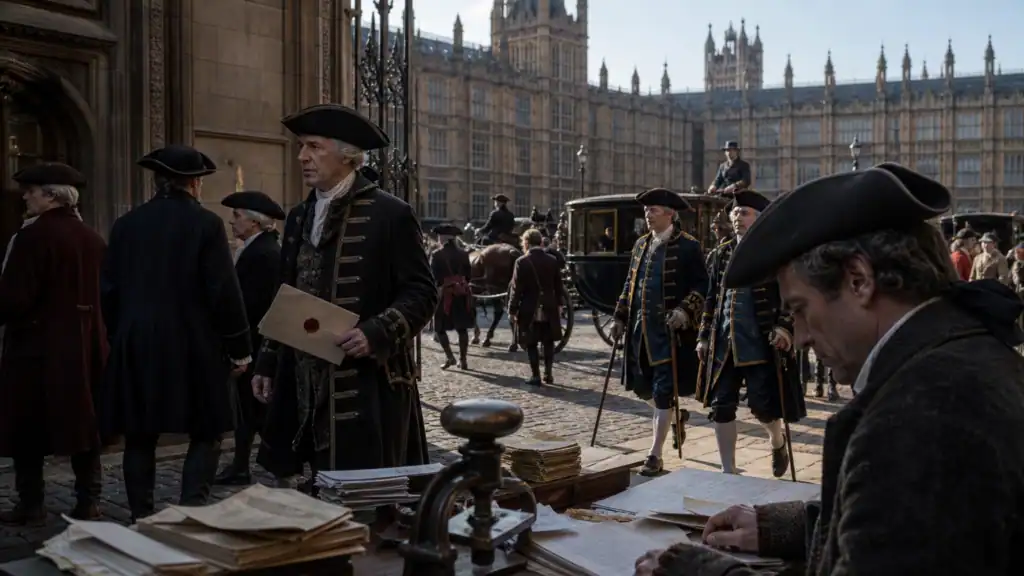
If the commissioners sought a constitutional bargain, much of the Scottish public saw something far more suspicious. Demonstrations broke out, pamphlets circulated, and accusations spread that Scotland had been sold. The language of betrayal was powerful because it gave shape to genuine fear. Many people believed that national independence had been traded away in exchange for English advantage and political convenience. The charge that Scotland had been bought was not merely an insult. It was a political diagnosis of how the settlement felt to those who opposed it.
That resentment should not be dismissed as irrational sentiment. The terms were complex, the stakes were high, and the benefits of union were far from immediately visible to ordinary Scots. For a population already wounded by the failure of Darien, the prospect of joining an England with greater resources could seem less like equality and more like absorption. The controversy was not a side note. It was part of the story of how the Union was made possible at all. Without pressure, compensation, and elite bargaining, it would not have passed.
The intensity of opposition also reveals something larger about political legitimacy. A constitution can be lawful and still be unpopular. It can be approved by Parliament and still feel imposed. In Scotland, the Union entered political memory as a settlement of necessity rather than affection. That memory shaped later British politics, because it ensured that Great Britain began life with unresolved questions at its core.
The Equivalent and the Politics of Compensation
Financial compensation was one of the most important tools used to make the Union possible. The Equivalent was designed to offset Scotland’s share of the English national debt and to help manage the economic disruption created by new customs and trade arrangements. It also helped address losses associated with the Darien scheme, which had become a symbol of Scottish financial injury. Money did not buy consent in any simple sense, but it made consent politically achievable.
This is a crucial point, because it reveals the practical machinery behind constitutional change. The Union was not built on lofty declarations alone. It depended on fiscal calculation, patronage, and the exchange of benefits across political lines. English politicians wanted security and commercial integration. Scottish elites wanted safeguards and compensation. The agreement survived because both sides could point to gains, even if those gains were uneven and contested.
That is also why the Union mattered so much for the future of the British state. It showed that institutions could be created through a blend of principle and finance. Protestant succession, common defence, and parliamentary authority were real. So were debt relief, trade access, and political reward. The settlement was stable because it addressed multiple crises at once. If you want to understand early eighteenth century Britain, you must understand that money was not separate from statecraft. It was one of its main instruments.
The Act Takes Effect
From Articles to Kingdom
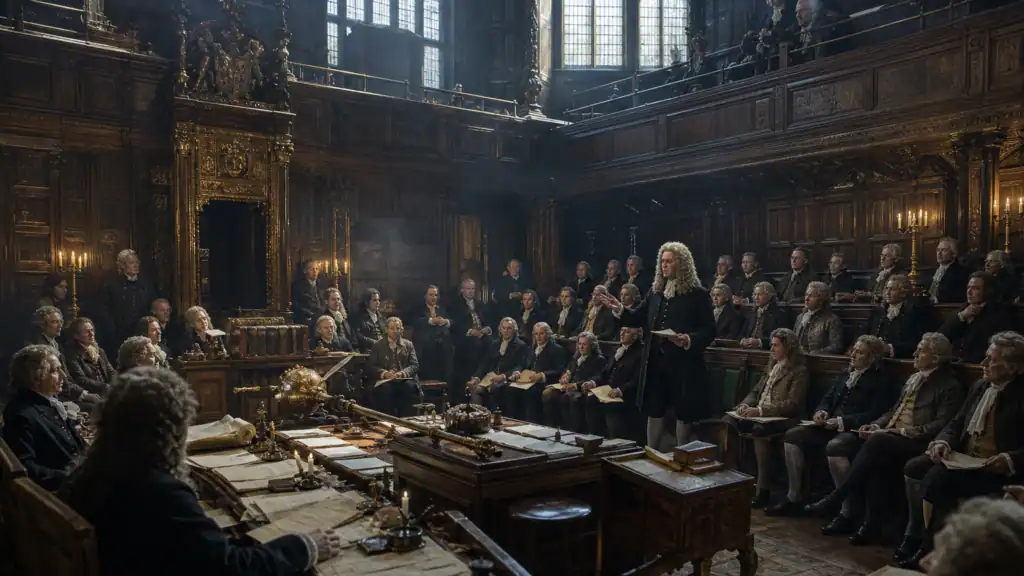
The Articles of Union were agreed in 1706 and approved by the separate Parliaments in 1706 and 1707. On 1 May 1707, the Kingdom of Great Britain came into existence. That date should not be imagined as a dramatic national awakening. There was no single spectacle that transformed popular identity overnight. The change came through legislation, administrative adjustment, and the quiet remaking of political structures.
That matters because constitutional history often looks more spectacular in retrospect than it felt at the time. For many people, the Union would have been experienced indirectly, through trade regulations, legal continuity, the movement of representatives to Westminster, and the changing language of sovereignty. Great Britain was not born in a blaze of popular unity. It was assembled by law, under pressure, in response to a strategic problem that had become too dangerous to ignore.
Anne’s role as the first monarch of Great Britain symbolised the new arrangement, but the symbolism should not be mistaken for simplicity. The crown now presided over a larger political entity, yet that entity still depended on negotiation between distinct traditions. The state had changed shape, but it had not become smooth or uniform. Its very existence depended on accepting a degree of historical complexity.
What Changed, and What Did Not
The most obvious practical change was the removal of customs barriers between England and Scotland. A shared Parliament at Westminster meant that political authority was now concentrated in a single legislature for the two kingdoms. The royal style was altered to reflect the new political reality. These changes created new possibilities for administration, trade, and imperial action. They also altered the balance of power within the island by giving the British state a greater capacity to act as one.
Yet many things remained unchanged. Scotland kept its own legal system. The Presbyterian Church endured. Languages, loyalties, and local identities did not vanish because Parliament had voted. That survival is essential to understanding the Union’s character. It was not a melting away of Scotland into England. It was a constitutional reordering that preserved difference while relocating authority.
That is why Great Britain was never simply a finished national project from the moment of union. It was a framework within which older identities continued to matter, sometimes peacefully and sometimes contentiously. The state became stronger, but it did so by recognising that strength in early eighteenth century Britain depended on accommodation as much as on power.

Conclusion
Queen Anne and the Act of Union mattered far more than the flat language of constitutional summaries suggests. If we reduce the event to a date in 1707, we miss the deeper transformation taking place in early eighteenth-century Britain. The union was not merely a legislative tidying-up exercise. It was a solution to a crisis that touched succession, religion, war, finance, trade, and the very meaning of sovereignty. It was driven by fear of what might happen if Anne died without an heir, by the danger that England and Scotland might drift into rival political futures, and by the practical need to stabilise a monarchy still shaped by the aftershocks of the Revolution of 1688.
That is why Queen Anne herself must be understood as more than a ceremonial figure in a gold gown beneath Westminster’s candles. She was a monarch operating within a new constitutional world, one where her influence mattered but where her power had to be exercised through Parliament, ministers, patronage, and careful listening. Her reign shows a monarchy becoming less absolute without becoming irrelevant. It shows a sovereign still able to shape events even as those events moved through institutions that no longer depended on royal command alone. That is a crucial feature of the age. Britain was not choosing between monarchy and Parliament as if one could simply replace the other. It was learning how authority would be shared, limited, and negotiated.
The Act of Union also deserves to be remembered for what it did not do. It did not erase Scotland. It did not create a perfectly uniform nation. It preserved Scottish law and the Presbyterian Church, and it left alive the memory of grievance, particularly over the financial pressures and political suspicion surrounding the settlement. Many people in Scotland believed, with good reason, that they had been forced into a compromise rather than welcomed into partnership. At the same time, English ministers saw union as a necessary safeguard against insecurity and foreign manipulation. The settlement endured because it answered different fears at once, even if it did not satisfy every party equally.
If you want the most honest lesson from this history, it is this. Great Britain was not born fully formed, proud, and inevitable. It was assembled under pressure. It was made by bargaining, calculation, compensation, and institutional redesign. That makes the Act of Union less neat than patriotic memory would like, but far more interesting and far more revealing. It changed the framework within which later British history unfolded, which is why it mattered so much then and still matters now.
If this has helped you see Queen Anne’s reign, the Act of Settlement of 1701, the Glorious Revolution and its legacy, the Darien scheme and Scottish finance, or the War of the Spanish Succession in a new light, I invite you to explore more of Digging Deep Histories. There is always another turning point hidden inside the decisions that seemed, at the time, merely necessary.