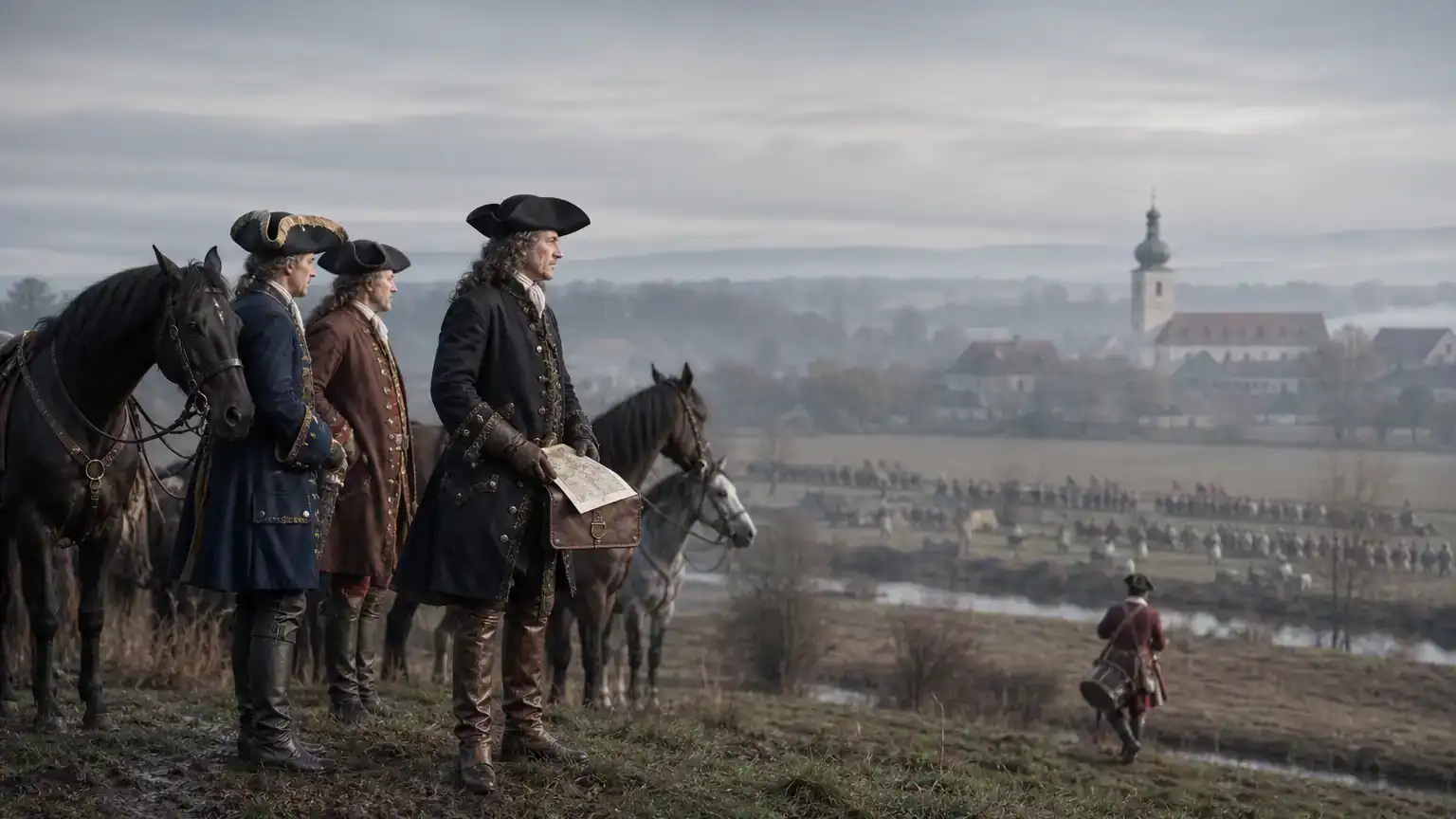
On the morning of 13 August 1704, the ground near Blenheim was still holding the night’s damp when the first guns opened. Mist hung over the Danube plain, the Nebel stream cut the field into awkward ground, and the French and Bavarian armies waited in a position that looked confident until one understood how much depended on a few hours of movement, timing, and nerve. John Churchill, Duke of Marlborough, stood watching from a rise above the battlefield, not as a romantic figure surveying destiny, but as a commander reading terrain, enemy deployment, and the limits of his own army. He had marched his men hundreds of miles. They were tired, multinational, and brittle in the way all coalition armies are brittle. Yet they had arrived in the right place, at the right moment, with a plan dangerous enough to fail spectacularly.
That is where the real importance of Marlborough’s victories begins. If you know Blenheim, Ramillies, Oudenarde, and Malplaquet as a list of famous names, the temptation is to treat them as episodes in the career of a brilliant general who simply outclassed his enemies. That view flatters the hero and hides the machinery of war. Marlborough’s achievement was not merely tactical. He understood how to move armies across Europe, how to keep allies committed, how to make supply lines function, and how to force his opponents into a series of choices that slowly reduced their freedom of action. He was fighting not only the French, but the geography of the continent, the pressures of coalition warfare, and the politics of governments that could abandon the war if victories did not justify the cost.
That is why these battles mattered more than their casualty lists suggest. They changed what Europe believed could be done by disciplined movement, operational concentration, and alliance management. They also showed the limits of military success. Marlborough could win the field and still lose political support at home. He could save Vienna and still leave the war unresolved. This was not a simple story of triumph. It was a lesson in how war is actually decided.
If you want to understand why Blenheim mattered, and why Ramillies, Oudenarde, and Malplaquet mattered even when they did not produce a clean final victory, we need to begin with the crisis that created the war itself.
Professor Steven Carmichael examines why Marlborough’s victories in the War of the Spanish Succession mattered far more than people usually realise.
The war behind Marlborough’s campaigns
The War of the Spanish Succession began in a succession crisis, but it became something much larger than a dynastic dispute. When Charles II of Spain died in 1700 without an heir, he left behind a composite monarchy that stretched across Spain, the Netherlands, Italy, and the wider imperial possessions of the Spanish crown. His will named Philip, Duke of Anjou, grandson of Louis XIV of France, as his successor. On paper, that sounded like a legal solution. In practice, it threatened to tilt the balance of Europe towards Bourbon power on a scale that alarmed every major court that depended on a rough equilibrium among the great states.
The fear was not just that Philip might rule Spain. It was that he might one day unite the Spanish inheritance with France. Even if such a union remained only a possibility, it was enough to sharpen the anxieties of England, the Dutch Republic, the Austrian Habsburgs, and several German states. None of them wanted to face a continent in which the richest colonial empire in Europe and the strongest military monarchy in Europe might become one strategic bloc. Trade routes, frontier security, and dynastic credibility all stood in the balance.
The Grand Alliance that formed against France and its allies therefore had a shared objective but not a single mind. The Dutch wanted the safety of their frontier barrier and the protection of commerce. The Emperor wanted to recover Spain for the Habsburg line and preserve Austria’s influence in Italy and Central Europe. England wanted to restrain France without committing itself to endless continental warfare that might drain money and men from its own interests. These were overlapping aims, not identical ones.
That distinction mattered because coalition warfare is always harder than war fought by one state with one command. Every allied army had to be fed, paid, and directed. Every magazine had to be stocked in advance. Every road and bridge mattered. Every retreat could turn into a political argument. A commander such as Marlborough was therefore operating inside a system, not above it. His victories had to be big enough to satisfy governments, credible enough to keep allies in the field, and decisive enough to stop France from dictating the terms of the conflict.
France was formidable in this environment. It had resources, interior lines, and experienced commanders. It could defend from strong positions and replace losses more easily than some of its opponents. This made the allies’ problem clear. They did not merely need courage. They needed the ability to move faster than the French expected, to concentrate strength at the decisive point, and to produce victories dramatic enough to alter political calculations across Europe. Marlborough’s genius lay in recognising that the battlefield was only the final stage of a much longer contest.
Blenheim and the breaking of French confidence
The summer of 1704 brought one of the most dangerous moments of the war. A French and Bavarian army threatened Vienna, and if the Imperial capital fell or was forced into submission, the entire balance of the conflict could be transformed. Marlborough responded with a march that remains remarkable not because it was glamorous, but because it was practical. He moved east with speed, secrecy, and political discipline, shifting forces from one theatre to another while keeping the French uncertain about his destination. He then linked up with Prince Eugene of Savoy, whose Imperial troops gave the coalition the strength it needed for a major offensive.
At Blenheim, Marshal Tallard deployed a French army that looked powerful and confident, but the position contained a fatal rigidity. He had crowded a large part of his force into and around the village of Blenheim, with other troops positioned across the field near Oberglau. The line appeared solid. In reality, it was too tightly packed and too fixed to respond smoothly once the fighting began. Marlborough saw that the French had created their own weakness by relying on concentration without flexibility.
The battle itself was brutal and uncertain. Allied infantry crossed the Nebel under fire, often in difficult ground that disrupted formations and made the assault more costly than any neat battlefield summary suggests. Marlborough pressed attacks on the flanks, pinning the French in place while the centre remained under pressure. This was not a single dramatic stroke but a sequence of coordinated efforts. The purpose was to make the French hold their ground in the wrong place for long enough that their centre could be struck decisively.
That decisive moment came when Marlborough committed cavalry against the weakened French centre. This was not a charge chosen for spectacle. It was the culmination of an operation built on fixing, stretching, and exhausting the enemy’s ability to manoeuvre. Once the French line gave way, the army collapsed as a coherent force. Marshal Tallard was captured. Thousands of French and Bavarian troops were killed, taken prisoner, or driven into flight towards the Danube.
The strategic effect was enormous. Vienna was saved. Bavaria was neutralised as an active threat. More than that, the myth of French invincibility in major field battle was shattered. Blenheim was not just a tactical victory. It told Europe that French armies could be beaten decisively if the allies combined speed, discipline, and careful concentration. That mattered because confidence is a military asset. Once the French could be forced back in open battle, the political ground beneath the war began to shift.
Yet Blenheim only makes sense if one sees how it was achieved. Marlborough did not simply arrive in the Danube theatre and improvise brilliance. He had organised the conditions for success long before the fighting began.
Victory built on movement and supply
The march to the Danube was a military operation in its own right. Marlborough concealed his intent from the French through deliberate uncertainty, managed information carefully, and used letters, couriers, and political pressure to sustain the illusion that his movements served other purposes. At the same time, his army required magazines, open roads, secure bridges, and the cooperation or compliance of local authorities who controlled access to supplies.
This is where early eighteenth century warfare becomes clearer than the old heroic image allows. An army was not just men with muskets. It was a moving administrative system. If the bread did not arrive, the soldiers slowed. If the horses failed, artillery lagged behind. If wagons broke down, ammunition and provisions became vulnerable to capture or delay. If a commander could not keep the machine moving, the battle would never happen on favourable terms.
Marlborough understood that logistics were combat power. He turned administration into advantage. By the time his troops reached the Danube, they had travelled far enough to surprise the enemy and yet retained enough cohesion to fight. That combination is the real reason Blenheim was so important. It proved that operational mobility could still be decisive even in an age often thought of as dominated by static sieges and fortress warfare.
This is also why the battle was more than a famous day of arms. It altered expectations. If armies could be moved across Europe, if supply could be organised with sufficient care, and if allied command could remain functional under pressure, then the war could not be reduced to a series of local defensive actions. The contest had become one of systems as much as swords.
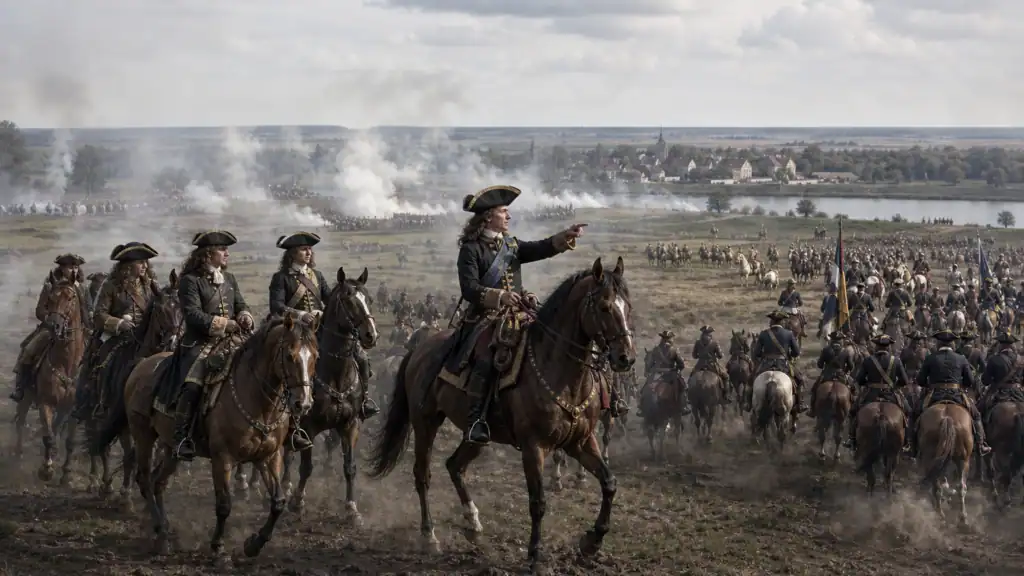
Ramillies and Oudenarde: Marlborough’s method in action
Blenheim was dramatic, but the enduring strength of Marlborough’s reputation rests on the fact that it was not a solitary triumph. Ramillies in 1706 and Oudenarde in 1708 demonstrated that his method could be repeated against different opponents and in different conditions. That matters because one battlefield success can always be dismissed as fortunate. Two or three victories, achieved through variation rather than repetition, begin to reveal command as a disciplined practice rather than a stroke of luck.
At Ramillies, Marlborough faced Marshal Villeroi on ground that was awkward and uneven, with marshy terrain complicating movement. He began by creating pressure on one part of the French line, encouraging the enemy to reinforce that sector. Then he shifted allied strength to another area, where the French had become vulnerable. This kind of battlefield manipulation depended on reading not just terrain but psychology. If the enemy believes one wing is under the greatest threat, they will weaken another. Marlborough’s task was to make the French respond in precisely the wrong way.
The result was a collapse in French cohesion. Allied cavalry struck with force against the exposed flank and rear, turning an orderly defence into a retreat. The battlefield victory mattered because it opened the Spanish Netherlands to allied advance. Fortified towns that had anchored French security in the region now fell one after another. In strategic terms, Ramillies did not merely win ground. It changed the map of pressure. France was forced to defend on a wider front and with less confidence in the security of its positions.
Oudenarde in 1708 showed a different side of the same method. This battle developed quickly, with troops arriving across the day in a confused and evolving situation. Marlborough and Prince Eugene had to coordinate under conditions where command could easily have fractured. The French, under the Dukes of Burgundy and Vendôme, struggled to organise their forces across difficult ground. Marlborough exploited that disorder by committing units where they would do the most damage, rather than waiting for perfect clarity that would never come.
That ability to act inside confusion is one reason Oudenarde matters. Early eighteenth century battles were often decided not by neat lines but by the moment when one side’s organisation began to fail. Marlborough understood that speed and coordination were themselves weapons. Once the French were driven back, the allies could move towards Lille. But even then, the battlefield did not produce an easy end to the war. Lille was one of Europe’s great fortresses, and taking it would reveal just how expensive success could be.
The cost of siege warfare
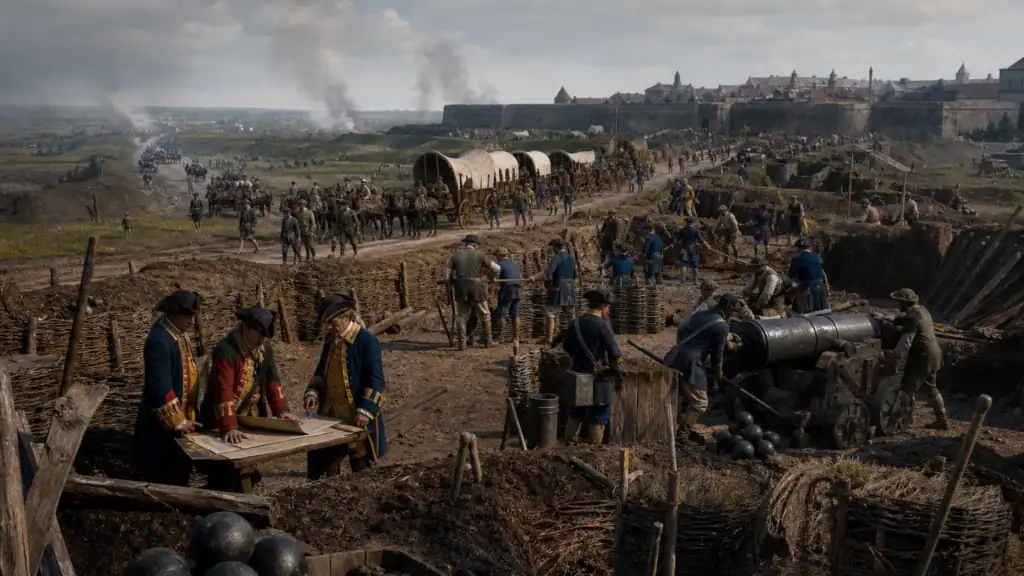
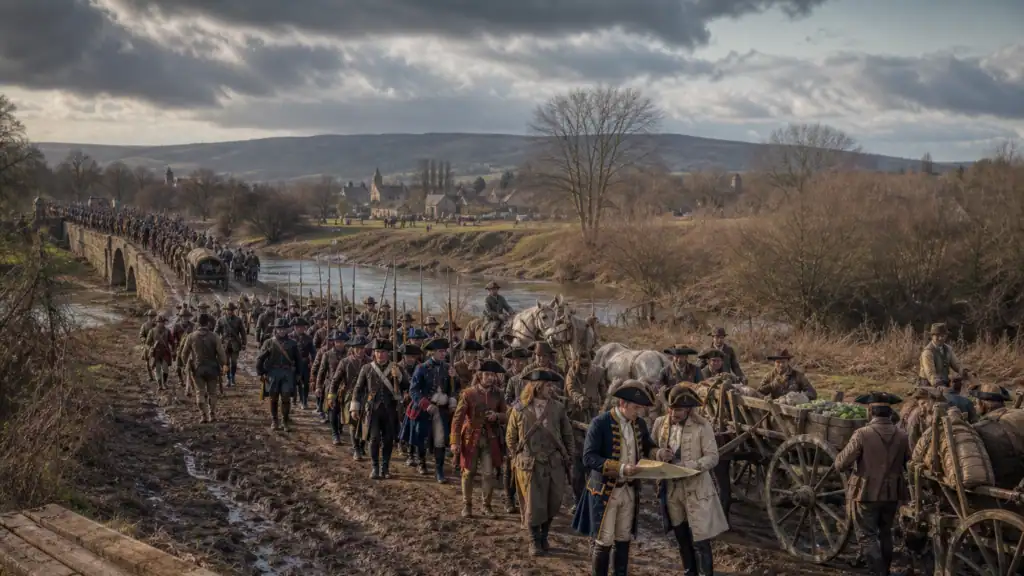
Lille exposed the hidden burden behind every victory. A battlefield defeat did not end resistance. Strong fortresses still had to be taken, and taking them demanded enormous expenditure of labour and materiel. Men were needed not only in the trenches but also along the roads, in the convoys, at the bridges, and guarding the lines of communication that kept the whole army alive. Guns had to be moved, earthworks dug, ammunition delivered, and the supply route protected against French attack.
This is where the image of Marlborough as a purely decisive battlefield commander becomes misleading. Sieges punished armies that had already won in the field. They consumed time, exposed supply lines, and drained the energy of troops who had expected momentum after victory. Every convoy was vulnerable. Every interruption mattered. The army in front of Lille was not simply besieging a fortress. It was managing a logistical contest under constant threat.
That challenge became even sharper at Malplaquet in 1709. The allies won the battle, but the cost was very high. French troops resisted with unusual tenacity from prepared positions, and allied assaults produced terrible losses. Strategically, the French were pushed back. Politically and psychologically, however, the victory was dangerous. It raised the question that always haunts protracted war: how many more such victories could the coalition endure before it lost the will to continue?
Malplaquet is essential to understanding Marlborough’s career because it reveals the boundary of military success. A commander can win the field and still weaken the coalition that made victory possible. Soldiers experience the war through the bodies of the dead and wounded. Governments experience it through expenditure, political pressure, and popular exhaustion. The difference between tactical gain and strategic sustainability became impossible to ignore.
The cost of winning and the politics of exhaustion
Marlborough’s battlefield record did not protect him from the politics of weariness. In fact, his success helped create the conditions for disappointment. Once Blenheim, Ramillies, and Oudenarde had shown what the allied armies could do, public expectation rose. People assumed that victory should now come more quickly, more cheaply, and more conclusively. When that failed to happen, the burden of the war became easier to criticise.
This was especially true in England, where political divisions sharpened over the war’s purpose and cost. The Whig ministry associated with Marlborough wanted to continue until France made serious concessions. Their opponents, the Tories, argued that the country had already paid too much in money and blood. Malplaquet gave that argument force. If even victory brought such severe losses, then what exactly was the public being asked to endure? The question was not abstract. It touched taxation, recruitment, and the burden on families who saw sons and brothers vanish into continental warfare.
Marlborough’s own enemies used that fatigue against him. His reputation, once elevated as the nation’s great protector, became entangled with accusations of ambition and overreach. That change tells us something important about early modern war. Success on the battlefield does not automatically translate into political security. A commander needs public confidence, parliamentary support, and a strategic settlement that people can imagine as worth the suffering. Marlborough’s victories had created leverage against France, but they had not created popular patience without limit.
This is why the political turn after 1710 matters so much. By then, the allies had pushed France onto the defensive and captured important strongholds, but the original fear of a Bourbon union had been moderated. Philip remained king of Spain, yet the crowns of France and Spain could not be united. That outcome was significant, but it was not the total destruction some had imagined at the start of the war. The war had become a negotiation over what kind of Europe would emerge, not a simple contest to erase one claimant entirely.
Marlborough was removed from command in 1711. Peace negotiations followed, and the Treaty of Utrecht in 1713 confirmed a settlement that recognised Philip as king of Spain on condition that the French and Spanish crowns remained separate. Britain gained strategic and commercial advantages. The Austrian Habsburgs acquired much of Spain’s European inheritance, though not the Spanish throne itself. This might seem to diminish Marlborough’s victories. In fact, it underlines their importance. Wars are not judged only by the ruler who remains in place. They are judged by the settlement they make unavoidable. Marlborough’s campaigns forced France into a weaker negotiating position and made compromise the only workable end.
What Marlborough’s victories really changed
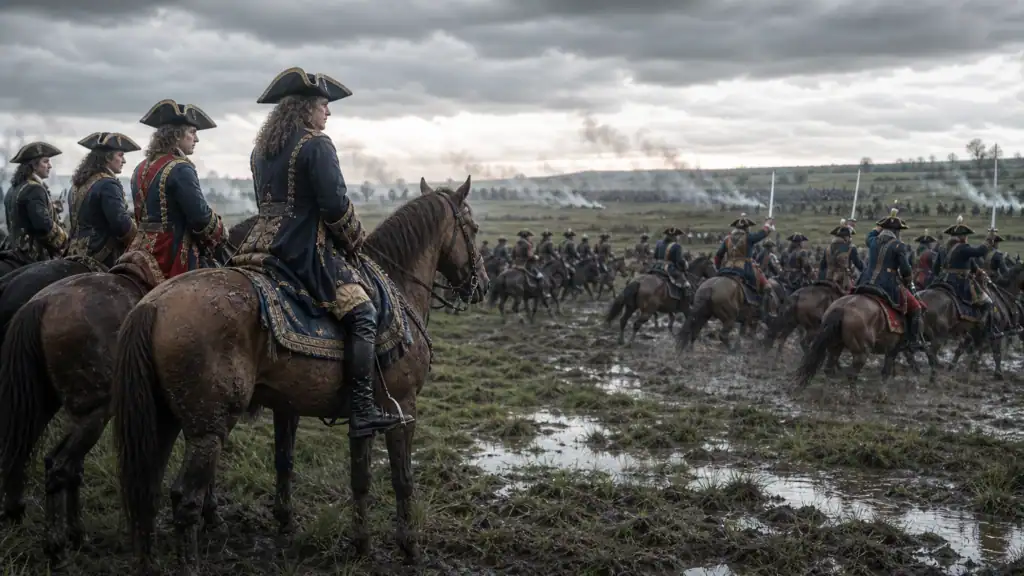
The deepest significance of Marlborough’s victories lies in how they changed European expectations about war. Before Blenheim, France could still appear to be the power that set the tempo. After Blenheim, the French could be defeated in open battle and their allies separated from them. Ramillies showed that a defensive system could unravel rapidly when its wings were forced out of position. Oudenarde demonstrated that confusion and poor coordination could be turned against a larger force if a commander was willing to act decisively inside uncertainty.
These were not merely battlefield lessons. They were lessons about the relationship between movement, concentration, and coalition management. Marlborough showed that armies could be broken not only by frontal assault, but by being made to occupy the wrong place at the wrong time. He showed that operations across great distances could produce strategic surprise. He showed that logistics were not the dull background of war, but one of its central weapons.
That is why his victories mattered more than people often realise. They changed the strategic language of Europe. Commanders after him had to think about speed, supply, and allied cohesion as essential parts of warfare, not secondary concerns. Governments had to judge whether an army could sustain pressure over years, not only whether it could win a single battle. The war became a test of systems.
At the same time, Marlborough’s career reminds us that military greatness has limits. He won famous victories, but he did not dictate peace entirely on his own terms. Philip remained on the Spanish throne. The war ended in compromise, not total Bourbon collapse. Yet that does not reduce Marlborough’s importance. It clarifies it. His victories did not erase the political realities of Europe, but they shaped the settlement from a position of strength. That is a different kind of achievement, and in many respects a more difficult one.
Marlborough’s place in history should therefore be understood not as the story of an unbeatable hero, but as the story of a commander who grasped how war really worked in the early eighteenth century. He understood that battle was the visible end of a long process involving roads, magazines, alliances, intelligence, and morale. He understood that one victory rarely settles a war. He understood that to win in Europe, one had to manage the machine behind the armies as carefully as the armies themselves.
If that changes how you see Blenheim, Ramillies, Oudenarde, and Malplaquet, then it has done what good history should do. It has replaced legend with understanding. Marlborough’s victories mattered because they exposed the true structure of power in war, and because they showed that great commanders do not simply strike harder than their enemies. They create the conditions in which their enemies can no longer recover.
If you have found this deeper look at Marlborough useful, continue exploring Digging Deep Histories for more military history that goes beyond names and dates, and into the decisions, systems, and consequences that shaped the past.